Published on Gelassen.in | Tea, Mindfulness & Mindful Living
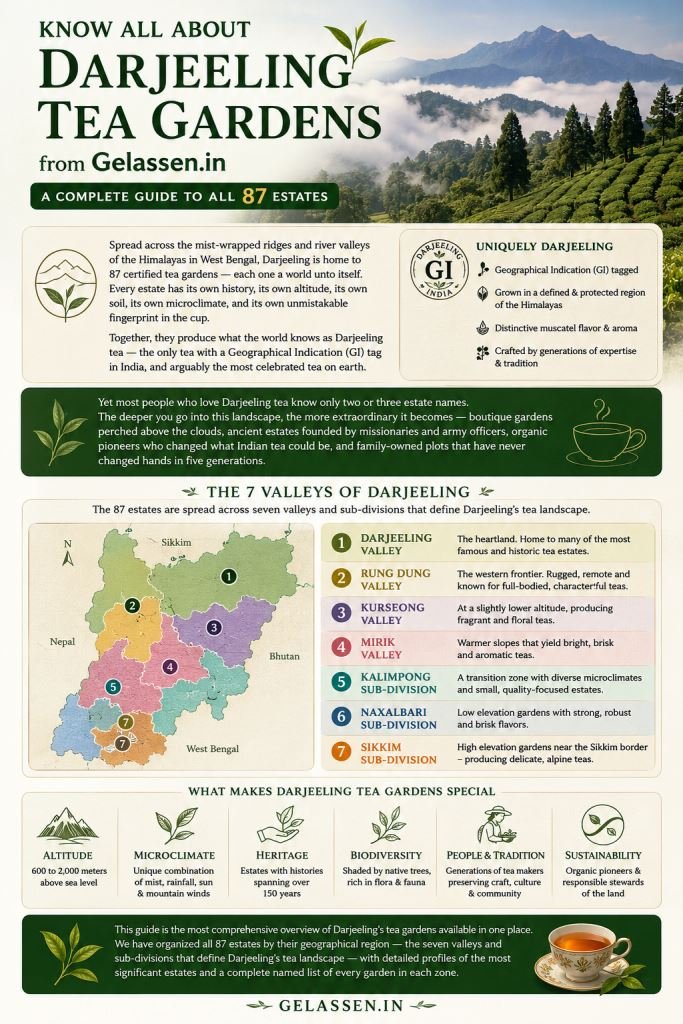
Spread across the mist-wrapped ridges and river valleys of the Himalayas in West Bengal, Darjeeling is home to 87 certified tea gardens — each one a world unto itself. Every estate has its own history, its own altitude, its own soil, its own microclimate, and its own unmistakable fingerprint in the cup. Together, they produce what the world knows as Darjeeling tea — the only tea with a Geographical Indication (GI) tag in India, and arguably the most celebrated tea on earth.
Yet most people who love Darjeeling tea know only two or three estate names. The deeper you go into this landscape, the more extraordinary it becomes — boutique gardens perched above the clouds, ancient estates founded by missionaries and army officers, organic pioneers who changed what Indian tea could be, and family-owned plots that have never changed hands in five generations.
This guide is the most comprehensive overview of Darjeeling’s tea gardens available in one place. We have organized all 87 estates by their geographical region — the seven valleys and sub-divisions that define Darjeeling’s tea landscape — with detailed profiles of the most significant estates and a complete named list of every garden in each zone.
At Gelassen, we believe that knowing the land behind your tea transforms the act of drinking into something richer. So read slowly, pour yourself a cup, and let the gardens of Darjeeling reveal themselves to you.
The Geography of Darjeeling Tea: Seven Valleys, One Legacy
Before exploring individual estates, it is essential to understand how Darjeeling’s tea geography is structured.
The 87 operational tea gardens in Darjeeling district cover an aggregated area of about 19,000 hectares under tea plantation. These estates employ approximately 52,000 permanent workers — with an additional 15,000 contract workers during the plucking season — and over 200,000 family members depend on estate wages. There are currently 72 active tea processing factories operating within the estates.
These gardens are spread across three administrative sub-divisions of Darjeeling district — Darjeeling Sadar, Kurseong, and Mirik — which together span seven distinct geographical valleys and growing zones. Each zone has a different altitude range, slope orientation, soil composition, and rainfall pattern — and these differences in tea are directly reflected in the character of the teas each area produces.
The seven principal growing regions are:
- Darjeeling West — High-altitude estates near Darjeeling town
- Darjeeling East — Eastern slopes with diverse microclimates
- Kurseong North — The organic heartland of Darjeeling
- Kurseong South — Premium quality estates, world-famous names
- Mirik Valley — High-altitude specialty gardens
- Upper Fagu / Teesta Valley — Eastern frontier gardens
- Kalimpong — Small but certified Darjeeling-producing zone
A tea must be grown and manufactured within the Darjeeling district to legally carry the Darjeeling GI certification mark. Teas from all seven regions qualify — provided they meet the Tea Board of India’s standards.
The History of Darjeeling’s Tea Gardens
The story of Darjeeling’s tea gardens begins in 1847, when the then British colonial government decided to establish experimental tea nurseries in the Darjeeling hills. The cool Himalayan climate, high altitude, and unique soil conditions — so similar in some ways to the tea-growing regions of southern China — made it a natural candidate for cultivation.
By 1852, the first three commercial tea plantations had been established: Tukvar (now Puttabong), Steinthal, and Aloobari Tea Estate. These early estates were founded by British planters, military officers, and occasional missionaries, who recognized the agricultural potential of the Himalayan foothills.
The industry grew rapidly through the second half of the 19th century. By 1874, there were 113 tea gardens in Darjeeling. The late Victorian era saw the industry reach its peak in number of estates — with well over 150 gardens operating at various points.
Over the 20th century, some estates closed due to economic pressures, labor disputes, or mismanagement. Today, 87 gardens remain operational — each certified by the Tea Board of India — collectively producing approximately 7–9 million kilograms of Darjeeling tea annually.
Region 1: Darjeeling West
Overview
The estates of Darjeeling West are clustered in the highland zone surrounding and just north of Darjeeling town itself. This is high-altitude terrain — with several gardens exceeding 2,000 metres above sea level — and the teas produced here tend to be delicate, floral, and highly aromatic. The area is characterized by dramatic mountain views, cool temperatures, and the mist that rolls in from the Rangeet River valley far below.
Featured Estates
🌿 Puttabong Tea Estate (formerly Tukvar)
Established: 1852 | Location: North Darjeeling West | Altitude: 600–2,200 m
Area: ~436 hectares | Owner: Jay Shree Tea & Industries Ltd.
Puttabong holds the distinction of being the oldest tea estate in Darjeeling, planted by the pioneering British tea planter Dr. A. Campbell in 1852. Originally known as Tukvar Tea Estate, it was renamed Puttabong after changing hands. Today it is the largest single tea estate in Darjeeling, stretching across approximately 20–22 square kilometres and divided into five divisions.
The River Rangeet flows through a portion of the garden, contributing to its rich biodiversity. The estate produces teas across the full altitude range — from 600 metres at the valley bottom to over 2,200 metres near the Sikkim border — creating dramatically different micro-terroirs within a single garden.
Puttabong is a specialist first flush producer, and its spring teas — particularly the celebrated Puttabong Clonal Queen (made from the AV2 clonal cultivar) and Puttabong Supreme — are among the most eagerly anticipated first flush releases of the season. The estate was also the first Darjeeling garden to receive ISO 9002:2008 certification in manufacturing and plantation management.
Signature teas: Puttabong Clonal Queen (First Flush), Puttabong Supreme
Tea types: Black, green, white
Known for: Exceptional first flush, largest estate, historic significance
🌿 Happy Valley Tea Estate
Established: 1854 | Location: 3 km north of Darjeeling town | Altitude: 2,100 m
Area: 177 hectares | Owner: Private management
Happy Valley is Darjeeling’s second oldest tea estate and one of its most visited — located just three kilometres from Chowk Bazar along Lebong Cart Road, making it the most accessible estate to the town of Darjeeling. Established in 1854, it sits at an impressively consistent 2,100 metres above sea level — one of the highest average altitudes of any estate in the district.
The estate employs more than 1,500 people and is well known for offering guided tours to visitors — taking guests through the entire oxidation process from leaf to cup, including a visit to the processing factory. Happy Valley produces a wide range of teas across all flushes, and its high altitude gives even its monsoon and autumnal teas a distinctive lightness and aromatic quality.
Signature teas: Happy Valley First Flush, Happy Valley FTGFOP1
Tea types: Black, green, white
Known for: Heritage, visitor accessibility, high-altitude character, tea tourism
🌿 Badamtam Tea Estate
Established: Late 19th century | Location: Darjeeling West | Altitude: 1,200–2,100 m
Area: ~300+ hectares | Owner: Goodricke Group
Badamtam is one of the five Darjeeling estates owned by the Goodricke Group — one of India’s largest and most respected tea companies. The estate is particularly celebrated for its first flush teas, which are prized for their bright, floral character and clean astringency. The Goodricke Group’s management standards ensure rigorous quality control across all flushes.
Tea types: Black, green
Known for: Excellent first flush, Goodricke Group quality standards
🌿 Barnesbeg Tea Estate
Established: Late 19th century | Location: Darjeeling West | Altitude: 1,400–2,100 m
Owner: Goodricke Group
Another Goodricke estate, Barnesbeg produces teas known for their consistent quality and characteristic Himalayan freshness. Located in the western highlands, its teas share the high-altitude delicacy of its neighbouring gardens.
Tea types: Black
Known for: Consistent quality, high-altitude character
🌿 Bannockburn Tea Estate
Established: 1870s | Location: Darjeeling West | Altitude: 1,200–2,000 m
A well-established garden in the western zone, Bannockburn produces good first flush teas known for their bright liquor and clean floral notes. The estate takes its name from the famous Scottish battlefield, reflecting its British origins.
Tea types: Black, green
Known for: Quality first flush, bright brisk character
🌿 Ging Tea Estate
Established: Late 19th century | Location: Darjeeling West | Altitude: 1,500–2,100 m
Ging is one of the moderately-sized western estates producing well-regarded orthodox teas across flushes. Its location in the western ridges gives its teas a characteristic cool clarity.
Tea types: Black
Known for: Well-rounded orthodox teas
🌿 Steinthal Tea Estate
Established: 1852 | Location: Near Darjeeling town
One of the original three commercial tea estates established in Darjeeling, Steinthal has the distinction of being among the founding gardens of the entire Darjeeling tea industry. Founded by German missionaries in the early 1850s, it was one of the earliest experiments in commercial tea cultivation in the Himalayas.
Tea types: Black
Known for: Historic significance as one of Darjeeling’s founding three gardens
Other gardens in Darjeeling West: Pandam, Phoobsering, Rangaroon, Rungneet, Singtom, Soom, North Tukvar
Region 2: Darjeeling East
Overview
The eastern zone of Darjeeling encompasses the slopes that face toward the Teesta River and the border regions with Sikkim. Estates here span a wide range of altitudes and benefit from the morning sun that hits the eastern slopes earlier and longer — often producing teas with distinctive brightness and fruity quality. This region has the most diverse microclimate variation of any zone, and its teas reflect that diversity.
Featured Estates
🌿 Arya Tea Estate
Established: 1885 | Location: Darjeeling East (Rungbong Valley) | Altitude: 900–1,820 m
Area: 125 hectares | Owner: Arya Tea Company Ltd. (Eurasia Group / KPL International)
Arya Tea Estate holds a fascinating origin story: it was reportedly first cultivated by Buddhist monks who grew Chinese tea here, and the original monks’ residence can still be seen within the estate. Originally known as “Sidrabong,” it was converted to a commercial estate in 1885.
Today, Arya is an organic certified estate celebrated for some of the most creatively named and distinctive teas in Darjeeling. Their specialty line includes:
- Ruby — a unique black tea with wine-like character
- Emerald — a prized organic green tea
- Pearl — a delicate white tea
- Diamond — bold whole-leaf with chunky golden tips
- Topaz — an oolong-style tea
About 60% of the estate’s bushes are China Clonal cultivars, with the remainder being hybrid types. Annual production from the factory is approximately 60,000–70,000 kg. Arya is one of the most innovative estates in Darjeeling — constantly experimenting with processing styles while maintaining certified organic integrity.
Signature teas: Arya Ruby, Arya Diamond, Arya Emerald, Arya Pearl
Tea types: Black, green, white, oolong
Known for: Innovation, organic certification, specialty named teas, creative processing
🌿 Risheehat Tea Estate
Established: Late 19th century | Location: Darjeeling East | Altitude: 1,200–1,800 m
Risheehat is a well-regarded eastern estate producing organic teas known for their floral and fruity aroma. It is particularly popular among consumers seeking fresh, naturally grown Darjeeling teas from this vintage region. The estate produces clean, bright first flush teas with a characteristic eastern slope luminosity.
Tea types: Black, green
Known for: Organic production, floral and fruity first flush
🌿 Lingia Tea Estate
Established: 1867 | Location: ~30 km west of Darjeeling town | Altitude: 900–1,800 m
Area: 220 hectares (141 under tea) | Owner: Chamong Group
The name “Lingia” derives from a Lepcha word meaning “Triangle of 8 peaks” — a fitting name for an estate nestled in one of the most scenically dramatic corners of Darjeeling. The plantation was originally started in 1867 by two German missionaries — one of several gardens in Darjeeling with missionary origins.
After changing hands multiple times, the Chamong Group — one of Darjeeling’s major corporate tea house groups — took over from Williamson Magor in 2001. The garden is now a bio-organic certified estate producing black and green teas from original China bush cultivars. It is located in a zone that straddles the eastern and western sub-divisions, giving it a unique transitional terroir.
Tea types: Black, green
Known for: Historic missionary origins, bio-organic certification, China bush cultivars
🌿 Pussimbing Tea Estate
Established: Late 19th century | Location: Darjeeling East | Altitude: 1,200–2,000 m
Pussimbing is known for producing aromatic and full-bodied teas with good complexity across flushes. The estate’s eastern exposure gives its teas a characteristic brightness and is particularly noted for well-structured first and second flush offerings.
Tea types: Black
Known for: Aromatic full-bodied teas, eastern-facing terroir
🌿 Mim Tea Estate
Established: Early 20th century | Location: Darjeeling East | Altitude: 1,400–2,000 m
Mim is one of the notable eastern estates producing consistent, quality Darjeeling teas. The estate also manages the adjacent Orange Valley (Bloomfield Tea Estate), making it a significant producing unit in the eastern zone.
Tea types: Black, green
Known for: Consistent quality, eastern slope character
Other gardens in Darjeeling East: Chongtong, Dhooteriah (Dooteriah), Kalej Valley, Liza Hill, Marybong, Rungmook/Cedars, Tumsong
Region 3: Kurseong North
Overview
The Kurseong North zone — situated in the northern portion of the Kurseong sub-division — is perhaps the most celebrated region for organic and biodynamic tea production in all of India. The combination of fertile Himalayan soils, moderate altitude, and a string of pioneering estates that committed to chemical-free farming decades before it was fashionable makes this area particularly significant for conscious tea consumers. The estates here tend to produce teas of exceptional purity and aromatic brightness.
Featured Estates
🌿 Ambootia Tea Garden
Established: 1850s | Location: Kurseong North | Altitude: 950–1,450 m
Area: 340 hectares | Owner: Sanjay Bansal (Ambootia Group)
Ambootia is one of Darjeeling’s most committed and celebrated biodynamic and organic estates — a complete philosophy of farming that extends well beyond simply avoiding chemicals. The estate is certified biodynamic, treating the entire farm as a living, self-sustaining ecosystem governed by lunar and cosmic rhythms.
The 340-hectare estate employs over 900 workers and produces an extraordinary range of tea types: black, green, white, and oolong — all organic, all estate-grown, all processed with meticulous care. Ambootia’s teas are particularly sought after in Europe and Japan, where organic certification and biodynamic farming are especially valued.
Signature teas: Ambootia First Flush, Ambootia Organic Silver Tips
Tea types: Black, green, white, oolong
Known for: Biodynamic certification, organic excellence, diverse tea types, premium export market
🌿 Margaret’s Hope Tea Estate
Established: 1864 | Location: Kurseong North | Altitude: 950–1,830 m
Area: 585 hectares | Owner: Goodricke Group
Margaret’s Hope has one of the most romantic origin stories in all of Darjeeling. The estate is named after Margaret, the daughter of its British owner Cruickshank, who fell in love with the estate during a visit from England and expressed her deep hope to return. She died before she could — and the estate was renamed in her memory.
Today, Margaret’s Hope is one of the largest and most prestigious estates in Darjeeling, spanning 585 hectares and producing some of the most sought-after teas in the district. Its second flush teas are particularly renowned for their intense muscatel character — the golden, grape-like aromatic quality that defines the finest summer Darjeeling. The first flush teas are equally accomplished — bright, floral, and distinctly Kurseong in character.
Margaret’s Hope is owned by the Goodricke Group, which maintains rigorous quality standards across all flushes and grades.
Signature teas: Margaret’s Hope Second Flush Muscatel, Margaret’s Hope FTGFOP1 First Flush
Tea types: Black, green
Known for: Intense muscatel second flush, romantic history, premium quality, Goodricke ownership
🌿 Balasun Tea Garden
Established: 1871 | Location: Kurseong North | Altitude: 365–1,375 m
Area: 181 hectares | Owner: Jay Shree Tea
Balasun is a well-established Jay Shree Group estate in the northern Kurseong zone. The estate spans a wide altitude range — from the lower valley at 365 metres to the upper ridges at 1,375 metres — giving it a broad spectrum of growing conditions and tea styles. Balasun is particularly noted for its muscatel-flavored teas, a quality associated with its warm summer conditions.
Tea types: Black
Known for: Muscatel notes, wide altitude range, Jay Shree Group management
Other gardens in Kurseong North: Dilaram, Eden Vale, Moondakotee, Oaks, Ringtong, Springside
Region 4: Kurseong South
Overview
Kurseong South is the crown of Darjeeling’s tea geography — home to several of the most legendary names in tea, estates that appear at the very top of connoisseurs’ lists worldwide. The zone includes both high-altitude boutique gardens and established estates with global recognition. The combination of Kurseong’s specific soil composition, the proximity of the lower Himalayan ridges, and ideal drainage conditions creates growing environments of extraordinary potential. Several of India’s most expensive and celebrated teas originate from this small but remarkable zone.
Featured Estates
🌿 Makaibari Tea Estate
Established: 1852 / Factory: 1859 | Location: Kurseong South (near Kurseong town) | Altitude: 600–1,500 m
Area: 270 hectares under tea (750 hectares total) | Owner: Luxmi Group / Banerjee family legacy
Makaibari is the most famous tea estate in Darjeeling — and arguably in the world. Its name in the local language means “land of maize” (makai = maize, bari = land), reflecting the agricultural history of this remarkable hillside.
Founded in 1852 by Captain Samler and soon acquired by the Banerjee family, Makaibari established the first tea processing factory in Darjeeling in 1859 — a factory that has been operating, in evolved forms, for over 165 years. It is the only estate in Darjeeling that is — at least historically — resident-owner managed through multiple generations. The fourth-generation planter, Swaraj Kumar (Rajah) Banerjee, led the estate from the 1970s and transformed it into a global icon.
Makaibari’s achievements are extraordinary:
- First tea garden in India to be certified organic (1988)
- First in Darjeeling to pioneer biodynamic farming in the tropics
- First to market Darjeeling green tea, white tea (Silver Tips), and oolong commercially
- One of the first to receive Fairtrade certification
- Pioneered community-based tourism with worker cottage accommodation
- Set world auction records — a single kilogram of Makaibari Silver Tips once sold for over ₹1 lakh
Of its 750 total hectares, approximately 65% is natural forest — the tea grows in a living ecosystem, not a monoculture. This ecological balance, Makaibari believes, is directly responsible for the extraordinary complexity and purity of its teas.
Signature teas: Makaibari Silver Tips (White Tea), Makaibari First Flush FTGFOP1, Makaibari Second Flush Muscatel
Tea types: Black, green, white, oolong
Known for: World-record prices, first organic Darjeeling estate, biodynamic farming, Silver Tips, ecological balance, tea tourism, historic significance
🌿 Castleton Tea Estate
Established: 1885 | Location: Kurseong South | Altitude: 980–2,300 m
Area: 170 hectares | Owner: Goodricke Group
Founded by Dr. Charles Graham in 1885, Castleton is synonymous with one thing above all others: muscatel. Among connoisseurs worldwide, Castleton’s second flush teas represent the pinnacle of the muscatel Darjeeling character — warm, grape-like, wine-like, complex, and deeply satisfying. The estate’s name has become shorthand for the finest summer Darjeeling that money can buy.
Spanning altitudes from nearly 1,000 metres to over 2,300 metres, Castleton’s elevation range gives it exceptional versatility — lower sections producing fuller, more robust teas, while the upper slopes generate the delicate, intensely aromatic teas that have made it legendary.
Single-estate Castleton second flush lots regularly command extraordinary prices at the Kolkata and Siliguri tea auctions. The estate is managed by the Goodricke Group, which also owns Thurbo, Badamtam, Barnesbeg, and Margaret’s Hope in Darjeeling.
Signature teas: Castleton Second Flush Muscatel, Castleton TGFOP1
Tea types: Black
Known for: The finest muscatel second flush in Darjeeling, auction records, Goodricke management, world-class prestige
🌿 Jungpana Tea Estate
Established: 1899 | Location: Kurseong South | Altitude: 1,000–1,500 m
Area: 78 acres (32 hectares) | Owner: Private
Jungpana was planted by Henry Montgomery Lennox in 1899 — the same pioneering planter who also established the nearby Goomtee estate in the same year. Despite its relatively small size — one of the more boutique estates in the region — Jungpana produces teas of extraordinary intensity and complexity that have earned it a devoted global following among serious tea collectors.
The estate’s teas — particularly the second flush muscatel lots — are whispered about reverently in tea circles. Their aromatic intensity, complexity, and sheer depth of character often rival or surpass estates twice their size. Jungpana lots sell out quickly each season, and collectors track new releases with the same anticipation applied to fine wine.
Signature teas: Jungpana Second Flush Muscatel, Jungpana FTGFOP1
Tea types: Black
Known for: Boutique intensity, world-class muscatel, collector status, Henry Montgomery Lennox heritage
🌿 Goomtee Tea Estate
Established: 1899 | Location: Kurseong South | Altitude: 900–1,800 m (approximately 4,000 ft average)
Area: 225 hectares | Owner: Ashok Kumar & Mahabir Prasad families (jointly)
Also planted by Henry Montgomery Lennox in 1899 alongside Jungpana, Goomtee is a bio-organic certified estate in south Kurseong. Approximately 50% of its 225 total hectares is under tea cultivation. The estate originally belonged to a single British planter family before passing through generations to the current joint ownership of the Kejriwal and Prasad families.
Goomtee is celebrated for producing vibrantly fresh and complex first flush teas — described by reviewers as possessing an almost “overpowering” freshness and vitality. The estate’s sweeping views of the Himalayan valleys and mountains also make it a popular destination for tea tourism.
Signature teas: Goomtee First Flush, Goomtee TGFOP1
Tea types: Black
Known for: Extraordinary fresh first flush, bio-organic, Henry Lennox heritage, tea tourism, family ownership
🌿 Giddapahar Tea Garden
Established: Early 20th century | Location: “Eagles Cliff,” Kurseong | Altitude: ~1,482 m average
Area: 109 hectares
Giddapahar — which translates roughly as “Eagle’s Cliff” — is a small but distinctive family-owned estate perched on a cliff in the Kurseong area. The estate is particularly well regarded for its Darjeeling green teas, which have a refined clarity and delicate Himalayan character. The cliff-edge location creates a unique microclimate with excellent airflow and drainage.
Tea types: Green, black
Known for: Exceptional Darjeeling green tea, family ownership, cliff-side terroir
🌿 Rohini Tea Garden
Established: Original opening in 1800s; reopened 1994 | Location: Southern Kurseong | Altitude: 1,500–2,300 m
Area: 138 hectares | Owner: Saria family (also own Gopaldhara)
Rohini has one of the most unusual histories of any Darjeeling estate: the garden was closed entirely from 1962 to 1994 — a 32-year dormancy. It was then taken over by the Saria family, who also own the celebrated Gopaldhara estate in the Mirik Valley. The Sarias replanted most of the garden with new tea bushes, though the uppermost portion of the estate still has original bushes over 100 years old — ancient plants that produce teas of remarkable depth and character.
Rohini is now a model of estate rehabilitation — demonstrating that with the right stewardship, a forgotten garden can become a producer of exceptional teas.
Tea types: Black
Known for: Historic closure and revival, ancient upper-estate bushes, Saria family stewardship
Other gardens in Kurseong South: Longview (Highlands), Mahalderam, Monteviot, Mullootar, Narbada Majhua, Nurbong, Selim Hill, Seepoydhura, Sivitar, Tindharia, Jogmaya, Mohan Majhua
Region 5: Mirik Valley
Overview
The Mirik Valley — spanning the Mirik sub-division — is one of Darjeeling’s most scenic and high-altitude growing zones. Gardens here are perched at elevations that regularly exceed 5,000 feet, with some reaching above 7,000 feet — conditions that push the boundaries of where the Camellia sinensis plant can thrive. The extreme altitude, combined with the valley’s specific east-west orientation and dramatic weather patterns, creates teas of exceptional floral intensity and complexity. Mirik is increasingly considered the region of the future for premium Darjeeling production, with several estates pioneering innovative tea types.
Featured Estates
🌿 Gopaldhara Tea Estate
Established: 1881 | Location: Mirik Valley (heart of the valley) | Altitude: 1,700–2,130 m (5,500–7,000 ft)
Area: 320 hectares (172 under tea) | Owner: Saria family
Gopaldhara is one of the highest tea estates in Darjeeling — and indeed, in the world. Situated at the very heart of the Mirik Valley at elevations from 5,500 to 7,000 feet above sea level, the estate’s extreme altitude and cool year-round temperatures create growing conditions of extraordinary intensity.
The Saria family has developed Gopaldhara into one of the most innovative and celebrated estates in the district. Their specialty teas — including the famous “Maharani of Darjeeling” first flush — are benchmarks for high-altitude Darjeeling character. The estate also produces outstanding silver needles and stupa-shaped white teas, hand-rolled oolong teas, and unique specialty varieties under names like Pearl, Olympic Flame, and Silver Needles.
Gopaldhara’s teas consistently rank among the finest produced in Darjeeling each season, particularly the first and second flush lots from their highest gardens.
Signature teas: Maharani of Darjeeling (First Flush), Gopaldhara Silver Needles, Gopaldhara Pearl
Tea types: Black, green, white, oolong — full range
Known for: Extraordinary altitude, innovative specialty teas, Maharani first flush, Saria family excellence
🌿 Thurbo Tea Estate
Established: 1872 | Location: Mirik Valley | Altitude: 980–2,440 m (3,220–8,010 ft)
Area: 485 hectares (172 under tea) | Owner: Goodricke Group
The name “Thurbo” is derived from the Nepali word Tombu, meaning tent — a reference to the British military encampments set up in this area during the Anglo-Nepalese conflict of the 1870s. The estate spreads across an extraordinary altitude range of nearly 1,500 metres — from under 1,000 metres at the valley floor to over 2,400 metres at its highest points.
Thurbo is owned by the Goodricke Group and is one of the most respected estates in the Mirik Valley for its first flush teas, which display exceptional floral intensity and clean, bright character. The high-altitude gardens under Kanchenjunga’s shadow produce teas with a distinctive delicacy and aromatic precision. The estate grows both China and Clonal tea bushes.
Signature teas: Thurbo First Flush TGFOP1, Thurbo Muscatel
Tea types: Black
Known for: Extraordinary altitude range, exceptional first flush, under Kanchenjunga, Goodricke management
🌿 Okayti Tea Estate
Established: 1870s | Location: Mirik Valley (near Indo-Nepal border, along Mechi River)
Altitude: 1,200–2,070 m (4,000–6,800 ft) | Area: 648 hectares (209 under tea)
Okayti — also known as the Rangdoo Tea Estate — is one of the largest estates in the Mirik Valley, flanked by Gopaldhara to the northeast and Thurbo to the east. The Mechi River runs along the Indo-Nepal border through its western boundary, and the estate houses a forest of local flora and fauna alongside its tea gardens.
Okayti is credited with having one of the oldest tea processing factories in the entire Darjeeling region, dating to the 1870s. Its teas are known for a perfect balance of astringency and a well-rounded, full body — with characteristic hints of dried fruit and nuts from the high-altitude growing conditions. Okayti produces excellent orthodox first and second flush black teas, as well as specialty green and white teas.
Signature teas: Okayti First Flush, Okayti Muscatel Second Flush
Tea types: Black, green, white
Known for: One of the oldest factories, forest biodiversity, balanced astringency, high-altitude full body
🌿 Singbulli Tea Garden
Established: Late 19th century | Location: Mirik Valley | Altitude: 1,200–1,900 m
Owner: Jay Shree Tea
Singbulli is a Jay Shree Group estate in the Mirik Valley, producing quality Darjeeling teas across flushes. The garden is particularly noted among connoisseurs for its fresh, balanced first flush character — a tea that reviewers describe as “vibrant and complex” with good depth for its delicacy.
Tea types: Black, green
Known for: Quality first flush, Mirik Valley freshness, Jay Shree Group
🌿 Seeyok Tea Estate
Established: Late 19th century | Location: Mirik Valley | Altitude: 1,500–2,000 m
A quality Mirik Valley estate producing floral, high-altitude Darjeeling teas. Seeyok’s elevated growing conditions contribute to a delicate, fragrant character across flushes.
Tea types: Black, green
Known for: Floral high-altitude character
🌿 Phuguri Tea Estate
Established: Early 20th century | Location: Mirik Valley | Altitude: 900–1,900 m
Area: 432 hectares (282 under tea) | Owner: Chamong Group
One of the larger Mirik estates, Phuguri produces approximately 170,000 kg of tea annually — a significant volume for a Darjeeling garden. The estate is managed by the Chamong Group and produces organic teas with a fresh, brisk character. The organic certification and the estate’s scale make it an important producer in the valley.
Tea types: Black (organic)
Known for: Large-scale organic production, Chamong Group management
🌿 Phoobsering Tea Estate
Established: Named after supervisor Phoob Tshering | Location: Mirik Valley | Altitude: 900–1,800 m (3,000–6,000 ft)
Area: 510 hectares (240 under tea) | Owner: Chamong Group
One of the largest estates in the Mirik zone by total area, Phoobsering was named after one of its early supervisors. The estate is owned by the Chamong Group and is a bio-organic farm — producing delicate white Darjeeling tea with pale brews and delicate floral flavors. Annual production is approximately 130,000 kg, with the estate’s white teas gaining increasing recognition in specialty markets.
Tea types: White (primary specialty), black
Known for: Bio-organic white tea production, large estate scale, Chamong Group
🌿 Chamong Tea Garden
Established: Late 19th century | Location: Mirik Valley | Altitude: 1,200–1,900 m
Owner: Chamong Group
The flagship estate of the Chamong Group — one of Darjeeling’s major corporate tea groups — Chamong produces a wide range of organic teas and is known for reliable, consistent quality across flushes and tea types. The group also manages Lingia, Phuguri, and Phoobsering among others.
Tea types: Black, green, white, oolong (organic)
Known for: Chamong Group flagship, wide range of organic teas
Other gardens in Mirik Valley: Ghayabaree & Millikthong, Sungma
Region 6: Upper Fagu / Teesta Valley
Overview
This zone covers the eastern frontier of Darjeeling’s tea-growing region — a long arc of estates stretching from the high ridges above Kurseong eastward toward the Teesta River corridor. The gardens here tend to be less well-known to international consumers but are increasingly valued by specialty tea buyers for their distinctive character — often more mineral, sometimes more muscatel, with a freshness that reflects the Teesta River valley’s unique atmospheric conditions.
Featured Estates
🌿 Avongrove Tea Garden
Established: Late 19th century | Location: Upper Fagu zone | Altitude: 1,200–2,000 m
Owner: Private (organic)
Avongrove is a premium organic estate in the Upper Fagu region known for producing exceptional first flush teas from AV2 clonal bushes. The estate has gained particular recognition for its first flush oolong teas — a relatively recent innovation that has quickly earned critical acclaim from specialty tea buyers. Avongrove demonstrates the extraordinary diversity of tea types now being produced in Darjeeling beyond conventional black tea.
Tea types: Black, green, white, oolong (organic)
Known for: Premium organic oolong, AV2 clonal teas, innovative processing
🌿 Glenburn Tea Estate
Established: 1859 | Location: Teesta Valley zone | Altitude: 900–1,800 m
Area: ~250 hectares | Owner: Private (Prakash family)
Glenburn is one of Darjeeling’s most atmospheric and internationally celebrated tea estates — not only for its teas but for its extraordinary luxury boutique hotel offering. The estate, founded in 1859 on a hillock overlooking the Kanchenjunga massif, is set where two rivers — the Rungeet and a smaller tributary — meet below the garden, creating an environment of rare natural beauty.
Two heritage bungalows — the Burra Bungalow and the Dak Bungalow — have been converted into intimate, immersive luxury retreats where guests participate in the full tea experience: guided walks through the gardens, learning to pluck, watching processing in the factory, and sitting down to gourmet meals. Glenburn has been recognized among the finest tea tourism destinations in the world.
The teas themselves are of premium quality — well-structured black teas across all flushes, with first flush offerings particularly prized for their delicate complexity.
Signature teas: Glenburn First Flush, Glenburn Second Flush
Tea types: Black
Known for: World-class tea tourism, luxury boutique hotel, Kanchenjunga views, two rivers, 1859 heritage
🌿 Namring Tea Estate
Established: Late 19th century | Location: Teesta Valley zone | Altitude: 1,200–2,100 m
Area: One of the larger Darjeeling estates | Owner: Private
Namring is one of the largest tea estates in Darjeeling and a producer of consistently excellent teas across all flushes. Its first flush offerings — smooth, delicate, and carrying distinctive honeyed floral notes — have made it a favourite among connoisseurs who prefer refinement and elegance over dramatic complexity.
The estate is also notable for offering tea tourism, with facilities for visitors who want to experience the garden environment and learn about tea processing.
Signature teas: Namring First Flush, Namring FTGFOP1
Tea types: Black, green
Known for: Smooth honeyed first flush, large-scale consistent quality, tea tourism
🌿 Lopchu Peshok Tea Garden
Established: Late 19th century | Location: Teesta Valley zone | Altitude: 900–1,600 m
Lopchu is a well-regarded estate in the Teesta Valley producing quality Darjeeling teas. The garden is known for its distinctive mineral quality — a reflection of the Teesta Valley’s unique geological substrate.
Tea types: Black
Known for: Mineral clarity, Teesta Valley character
Other gardens in Upper Fagu / Teesta Valley: Nagri, Nagri Farm, Selimbong, Teesta Valley, Tukdah, Turzum, Dhajea, Runglee Rungliot, Samebeong
Region 7: Kalimpong
Overview
The Kalimpong sub-division is the smallest of Darjeeling’s tea-producing zones. While much of Kalimpong’s land was historically under cultivation before tea arrived, or belongs to the Forest Department, a small number of estates here are fully certified to produce Darjeeling tea under the GI tag.
Key Estates in Kalimpong
🌿 Upper Fagu Tea Estate
Location: Kalimpong hills | Altitude: 1,200–2,000 m
One of the highest estates in the Kalimpong zone, Upper Fagu produces delicate teas with a distinctive high-altitude purity. The estate has gained recognition for its organic processing.
Tea types: Black, green
Known for: High-altitude Kalimpong character
Other certified estates in Kalimpong: Ambiok (Hillton), Mission Hill, Kumai (Snow View), Samabeong
The Complete Named List of All 87 Darjeeling Tea Gardens
For reference and completeness, here is the comprehensive named list of all 87 certified Darjeeling tea gardens, organized by region:
Darjeeling West
Badamtam | Bannockburn | Barnesbeg | Ging | Happy Valley | North Tukvar | Pandam | Phoobsering | Puttabong (Tukvar) | Rangaroon | Rungneet | Singtom | Soom | Steinthal
Darjeeling East
Arya | Chongtong | Dhooteriah (Dooteriah) | Kalej Valley | Lingia | Liza Hill | Marybong | Mim (including Orange Valley / Bloomfield) | Pussimbing | Risheehat | Rungmook / Cedars | Tumsong
Kurseong North
Ambootia | Balasun | Dilaram | Eden Vale | Margaret’s Hope | Moondakotee | Oaks | Ringtong | Springside
Kurseong South
Castleton | Giddapahar | Goomtee | Jogmaya | Jungpana | Longview (Highlands) | Mahalderam | Makaibari | Mohan Majhua | Monteviot | Mullootar | Narbada Majhua | Nurbong | Rohini | Selim Hill | Seepoydhura | Sivitar | Tindharia
Mirik Valley
Chamong | Ghayabaree & Millikthong | Gopaldhara | Okayti (Rangdoo) | Phuguri | Phoobsering | Seeyok | Singbulli | Sungma | Thurbo
Upper Fagu / Teesta Valley
Avongrove | Dhajea | Glenburn | Lopchu Peshok | Nagri | Nagri Farm | Namring | Runglee Rungliot | Samebeong | Selimbong | Teesta Valley | Tukdah | Turzum
Kalimpong
Ambiok (Hillton) | Kumai (Snow View) | Mission Hill | Samabeong | Upper Fagu
Understanding Estate Ownership: The Major Tea Groups
Several major corporate groups own and manage clusters of Darjeeling estates:
| Group | Estates in Darjeeling |
|---|---|
| Goodricke Group | Castleton, Thurbo, Badamtam, Barnesbeg, Margaret’s Hope |
| Jay Shree Tea & Industries | Puttabong, Risheehat, Singbulli, Sungma, North Tukvar, Balasun |
| Chamong Group | Chamong, Lingia, Phuguri, Phoobsering |
| Saria Family | Gopaldhara, Rohini |
| Luxmi Group | Makaibari (current management) |
| Ambootia Group | Ambootia, others |
| KPL International / Eurasia | Arya |
Independent family-owned estates — such as Jungpana, Goomtee, Happy Valley, Glenburn, and Avongrove — tend to attract particular interest from specialty buyers and connoisseurs, as family ownership often allows for greater creative freedom in processing and stronger personal commitment to quality.
How to Read the Terroir: What Each Region Tastes Like
| Region | Altitude | Dominant Character | Notable Qualities |
|---|---|---|---|
| Darjeeling West | 1,200–2,200 m | Delicate, floral, high-altitude freshness | Clean, light, very aromatic |
| Darjeeling East | 900–2,000 m | Bright, fruity, diverse | Eastern-facing luminosity, good complexity |
| Kurseong North | 950–1,830 m | Organic purity, bright aromatic | Biodynamic quality, clean profiles |
| Kurseong South | 980–2,300 m | Premium complexity, muscatel excellence | World’s finest second flush, prestige estates |
| Mirik Valley | 1,200–2,440 m | Intensely floral, high-altitude precision | The highest gardens, exceptional first flush |
| Teesta Valley | 900–1,800 m | Mineral clarity, smooth depth | River valley freshness, good second flush |
| Kalimpong | 1,200–2,000 m | Delicate, pure, less well-known | Rare, clean high-altitude teas |
How to Choose a Darjeeling Tea Garden: A Buyer’s Guide
With 87 estates producing teas of dramatically different character, choosing the right Darjeeling tea can feel overwhelming. Here is a practical guide:
If you want the finest first flush: Look to Puttabong, Thurbo, Gopaldhara, Namring, Jungpana, or Goomtee — all celebrated for exceptional spring teas.
If you want the finest muscatel second flush: Castleton, Jungpana, Margaret’s Hope, and Balasun are the benchmark estates.
If you want organic or biodynamic: Makaibari, Ambootia, Gopaldhara, Rohini, Avongrove, Arya, and Phuguri are all certified.
If you want innovative specialty teas: Arya (Ruby, Emerald, Diamond), Gopaldhara (Silver Needles, Maharani), and Avongrove (oolong) are leading the way.
If you want tea tourism: Glenburn (luxury boutique), Happy Valley (accessible tours), Makaibari (community tourism), and Namring (garden visits) are the most visitor-friendly.
If you are buying on a moderate budget: Well-managed estates like Singbulli, Balasun, Margaret’s Hope (lower grades), and Rohini offer excellent value.
Frequently Asked Questions
Q: How many tea gardens are there in Darjeeling?
There are 87 operational, certified tea gardens in Darjeeling district, spread across three sub-divisions and seven principal growing valleys. This number has been consistent in recent years, though it has fluctuated historically as some estates have closed and a few have reopened.
Q: Which is the oldest tea garden in Darjeeling?
Puttabong (formerly Tukvar) Tea Estate, established in 1852 by Dr. A. Campbell, is officially the oldest tea garden in Darjeeling. Makaibari and Steinthal were also established in 1852 and are among the very earliest. Happy Valley (1854) and Glenburn (1859) are other historic early estates.
Q: Which is the largest tea garden in Darjeeling?
Puttabong Tea Estate is the largest, covering approximately 436 hectares under tea across five divisions, spanning roughly 20–22 square kilometres.
Q: Which Darjeeling tea garden produces the most expensive tea?
Makaibari Tea Estate has produced some of the most expensive teas in history — particularly its Silver Tips white tea, which has sold for over ₹1 lakh per kilogram at auction. Jungpana and Castleton second flush muscatel lots also command some of the highest prices each season.
Q: How many tea gardens in Darjeeling are organic
A significant and growing number of Darjeeling’s 87 estates are certified organic. Key organic estates include Makaibari, Ambootia, Arya, Gopaldhara, Rohini, Avongrove, Phuguri, Phoobsering, and several others. The trend toward organic certification has accelerated significantly in the 21st century.
Q: Which is the highest altitude tea garden in Darjeeling?
Gopaldhara Tea Estate in the Mirik Valley, with gardens reaching up to 2,130 metres (approximately 7,000 feet) above sea level, is one of the highest tea-growing estates in Darjeeling — and among the highest commercially producing tea gardens in the world.
Q: Which Darjeeling tea garden is best for tourism?
Glenburn Tea Estate offers the most immersive luxury tea tourism experience in Darjeeling, with heritage bungalows, gourmet dining, and guided garden experiences. Happy Valley is the most accessible and popular for day visitors. Makaibari offers unique community-based accommodation and cultural immersion.
Q: Can I visit Darjeeling tea gardens as a tourist?
Yes — many estates welcome visitors, particularly during the flush seasons (March–June and October–November). Happy Valley, Glenburn, Makaibari, Namring, and Goomtee are among the most visitor-friendly. Always contact the estate in advance to arrange a visit.
The Gelassen Perspective: A Landscape of Patience and Craft
Exploring the list of Darjeeling’s 87 tea gardens is an exercise in understanding how place shapes character — how a few hundred metres of altitude, an east- versus west-facing slope, or an ancient versus newly planted bush can produce teas of dramatically different temperament.
It is also an exercise in understanding human stories. The Banerjee family of Makaibari, who saw the potential for organic and biodynamic farming when nobody else in India was thinking that way. The Saria family, who took over the closed and abandoned gardens of Rohini and gave them new life. Henry Montgomery Lennox, who planted both Jungpana and Goomtee in the same year and created two of Darjeeling’s most celebrated legacies simultaneously. The German missionaries who started Lingia with no commercial motive beyond cultivating good land.
Behind every estate name on this list is a story of patience, of risk, of love for a landscape that rewards careful attention with extraordinary flavor.
This is the world in your cup — not just tea, but a hundred and seventy years of human devotion to a hillside, a leaf, and the slow alchemy that makes both of them matter.
Explore more about tea culture, wellness, and mindful living at gelassen.in
Tags: list of Darjeeling tea gardens, 87 Darjeeling tea estates, Darjeeling tea garden names, Makaibari, Castleton, Glenburn, Thurbo, Jungpana, Gopaldhara, best Darjeeling tea gardens, Darjeeling tea estate regions, tea garden map, organic Darjeeling tea, Darjeeling tea tourism