Published on Gelassen.in | Tea, Mindfulness & Mindful Living
Pour yourself a cup. Look at its color — golden, amber, pale green, or deep mahogany. Inhale the aroma — grassy, floral, malty, smoky. Now consider this:
Every difference you can see, smell, and taste in that cup is the result of one extraordinary natural process: oxidation.
Whether you’re a lifelong chai drinker, a green tea devotee, or someone just beginning to explore the world of tea, understanding oxidation is the key to understanding tea itself. It’s the quiet chemistry that transforms a simple green leaf into one of the most diverse, nuanced beverages in human history.
At Gelassen, we believe that slowing down to understand what’s in your cup deepens the experience of drinking it. So let’s explore — unhurriedly and thoroughly — the fascinating science and art of tea oxidation.
What Is Oxidation in Tea?
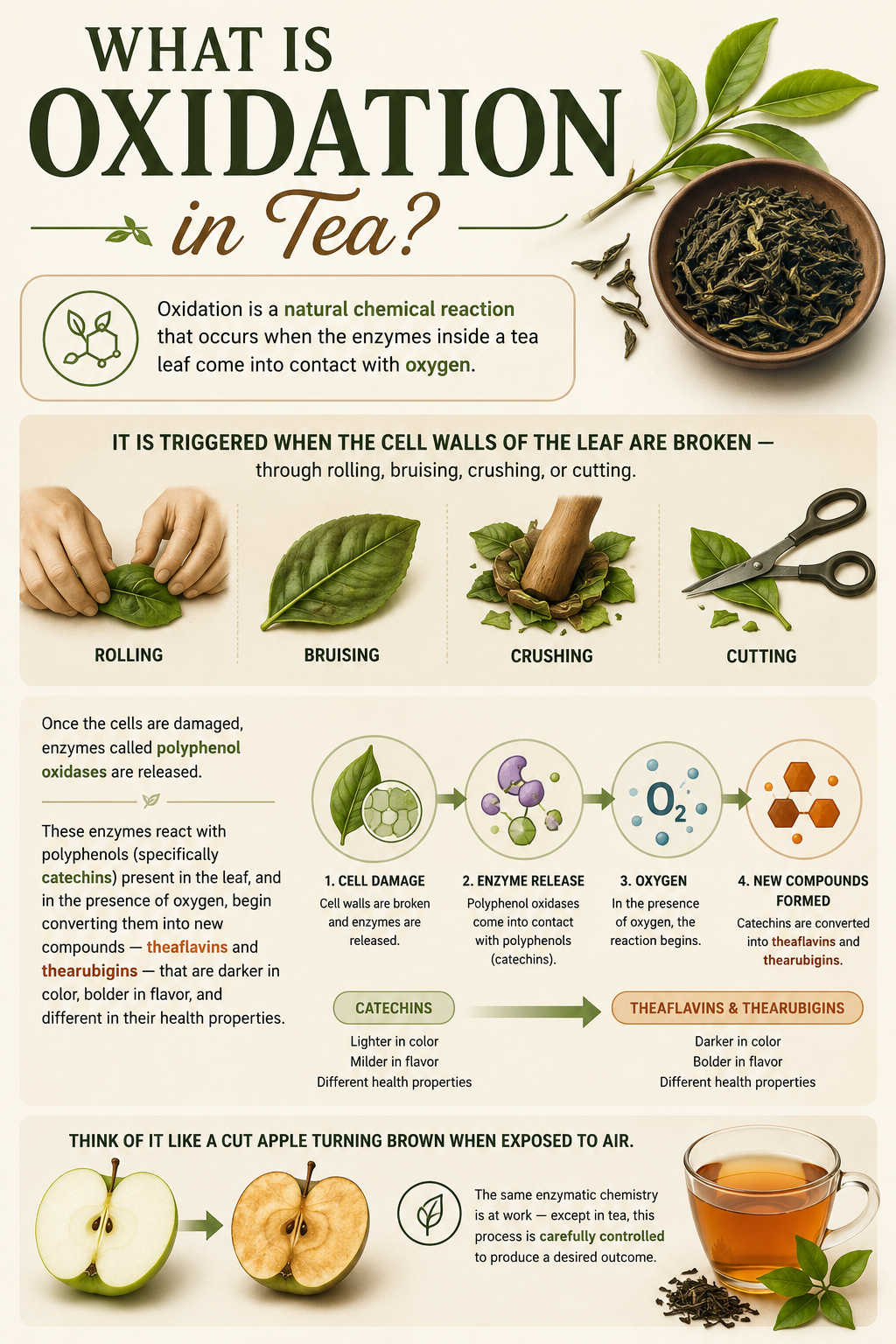
Oxidation is a natural chemical reaction that occurs when the enzymes inside a tea leaf come into contact with oxygen. It is triggered when the cell walls of the leaf are broken — through rolling, bruising, crushing, or cutting.
Once the cells are damaged, enzymes called polyphenol oxidases are released. These enzymes react with polyphenols (specifically catechins) present in the leaf, and in the presence of oxygen, begin converting them into new compounds — theaflavins and thearubigins — that are darker in color, bolder in flavor, and different in their health properties.
Think of it like a cut apple turning brown when exposed to air. The same enzymatic chemistry is at work — except in tea, this process is carefully controlled to produce a desired outcome.
Important distinction: Oxidation is not the same as fermentation. Fermentation involves microorganisms (bacteria, yeast), while oxidation is an enzymatic reaction. However, some aged teas like Pu-erh do undergo true microbial fermentation, and the terms are often — incorrectly — used interchangeably.
How Does Tea Oxidation Happen? A Step-by-Step Look
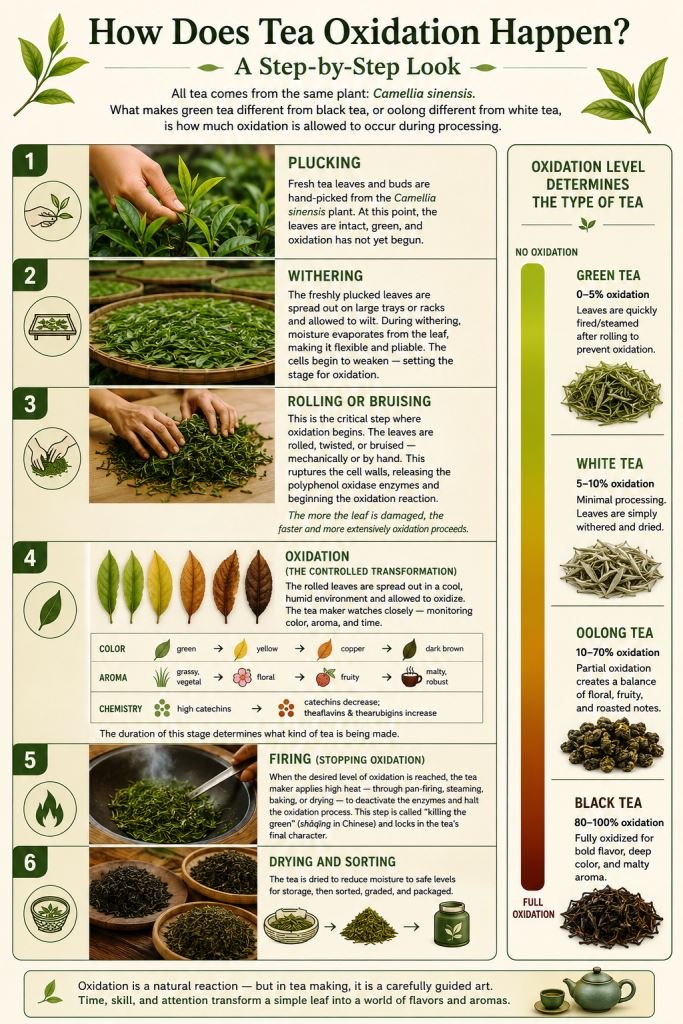
All tea comes from the same plant: Camellia sinensis. What makes green tea different from black tea, or oolong different from white tea, is how much oxidation is allowed to occur during processing.
Here’s the general sequence of tea production where oxidation plays its role:
Step 1: Plucking
Fresh tea leaves and buds are hand-picked from the Camellia sinensis plant. At this point, the leaves are intact, green, and oxidation has not yet begun.
Step 2: Withering
The freshly plucked leaves are spread out on large trays or racks and allowed to wilt. During withering, moisture evaporates from the leaf, making it flexible and pliable. The cells begin to weaken — setting the stage for oxidation.
Step 3: Rolling or Bruising
This is the critical step where oxidation begins. The leaves are rolled, twisted, or bruised — mechanically or by hand. This ruptures the cell walls, releasing the polyphenol oxidase enzymes and beginning the oxidation reaction.
The more the leaf is damaged, the faster and more extensively oxidation proceeds.
Step 4: Oxidation (The Controlled Transformation)
The rolled leaves are spread out in a cool, humid environment and allowed to oxidize. The tea maker watches closely — monitoring color, aroma, and time.
- As oxidation progresses, the leaves gradually change from green → yellow → copper → dark brown
- The aroma shifts from grassy and vegetal → floral → fruity → malty and robust
- The catechin content decreases, and theaflavins and thearubigins increase
The duration of this stage determines what kind of tea is being made.
Step 5: Firing (Stopping Oxidation)
When the desired level of oxidation is reached, the tea maker applies high heat — through pan-firing, steaming, baking, or drying — to deactivate the enzymes and halt the oxidation process. This step is called “killing the green” (shāqīng in Chinese) and locks in the tea’s final character.
Step 6: Drying and Sorting
The tea is dried to reduce moisture to safe levels for storage, then sorted, graded, and packaged.
Oxidation Levels and Types of Tea
The entire spectrum of tea — from the lightest white to the darkest black — is a spectrum of oxidation. Here is how each major category sits on that scale:
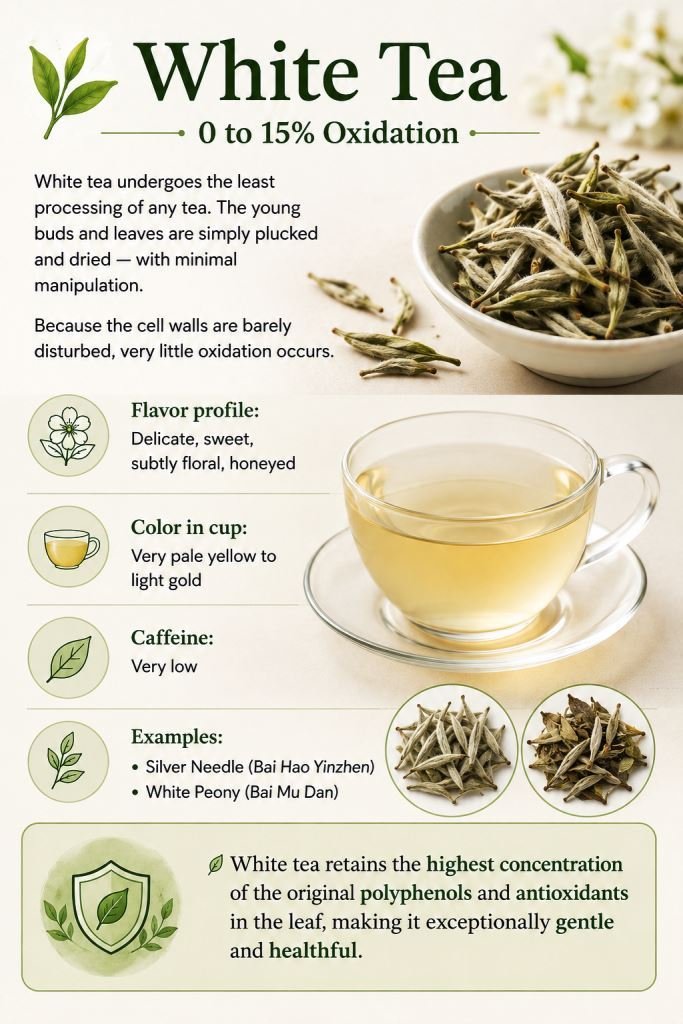
🍃 White Tea — 0 to 15% Oxidation
White tea undergoes the least processing of any tea. The young buds and leaves are simply plucked and dried — with minimal manipulation. Because the cell walls are barely disturbed, very little oxidation occurs.
Flavor profile: Delicate, sweet, subtly floral, honeyed
Color in cup: Very pale yellow to light gold
Caffeine: Very low
Examples: Silver Needle (Bai Hao Yinzhen), White Peony (Bai Mu Dan)
White tea retains the highest concentration of the original polyphenols and antioxidants in the leaf, making it exceptionally gentle and healthful.
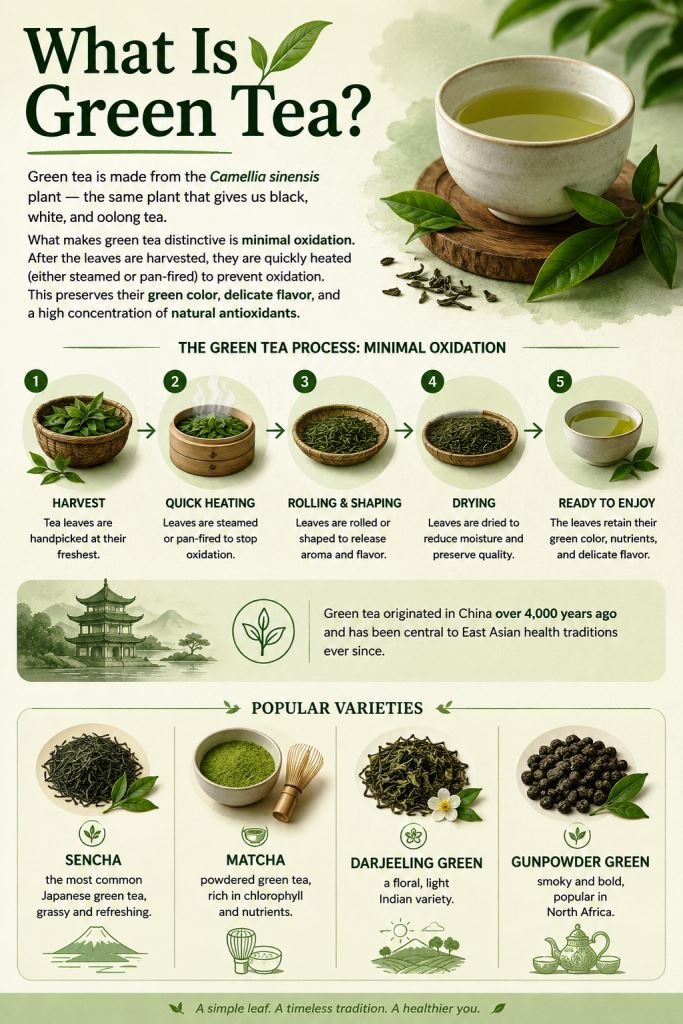
🍵 Green Tea — 0 to 12% Oxidation
Green tea is produced by quickly applying heat after plucking to destroy the oxidizing enzymes before they can act. In Japan, this is done by steaming (producing a more vegetal, umami flavor). In China, it’s typically done by pan-firing in a wok (producing a nuttier, toastier flavor).
Because oxidation is stopped almost immediately, green tea retains its green color and its high catechin content — particularly EGCG (Epigallocatechin gallate), its most celebrated antioxidant.
Flavor profile: Grassy, vegetal, umami, fresh, sometimes nutty
Color in cup: Pale yellow to soft green
Caffeine: Low to moderate (25–45 mg per cup)
Examples: Sencha, Gyokuro, Dragon Well (Longjing), Matcha, Darjeeling Green
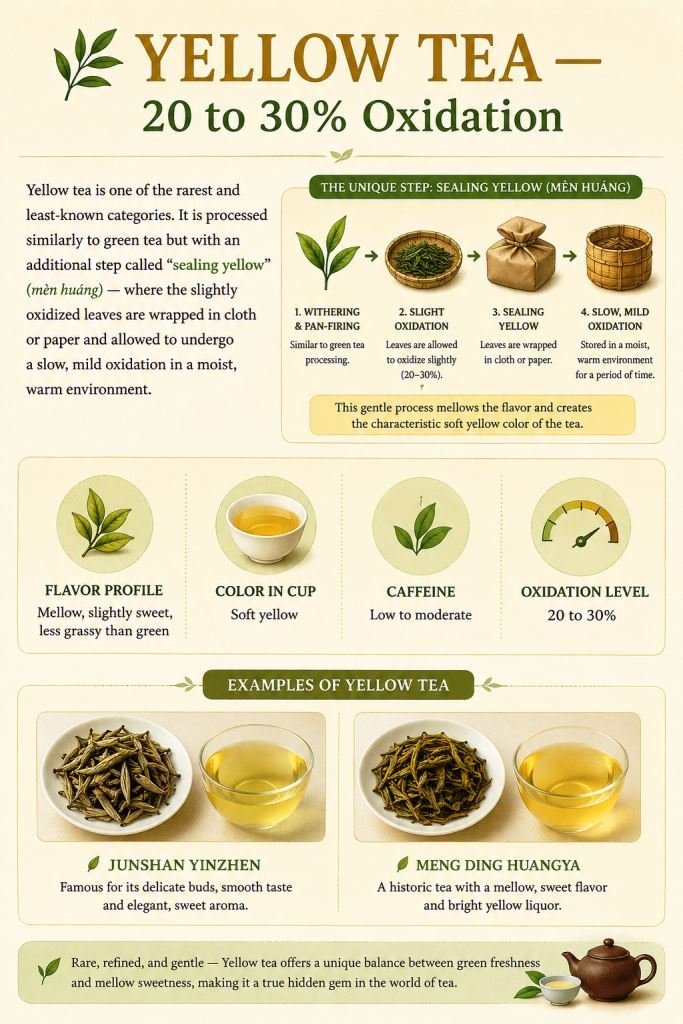
🌿 Yellow Tea — 20 to 30% Oxidation
Yellow tea is one of the rarest and least-known categories. It is processed similarly to green tea but with an additional step called “sealing yellow” (mèn huáng) — where the slightly oxidized leaves are wrapped in cloth or paper and allowed to undergo a slow, mild oxidation in a moist, warm environment.
Flavor profile: Mellow, slightly sweet, less grassy than green
Color in cup: Soft yellow
Caffeine: Low to moderate
Examples: Junshan Yinzhen, Meng Ding Huangya
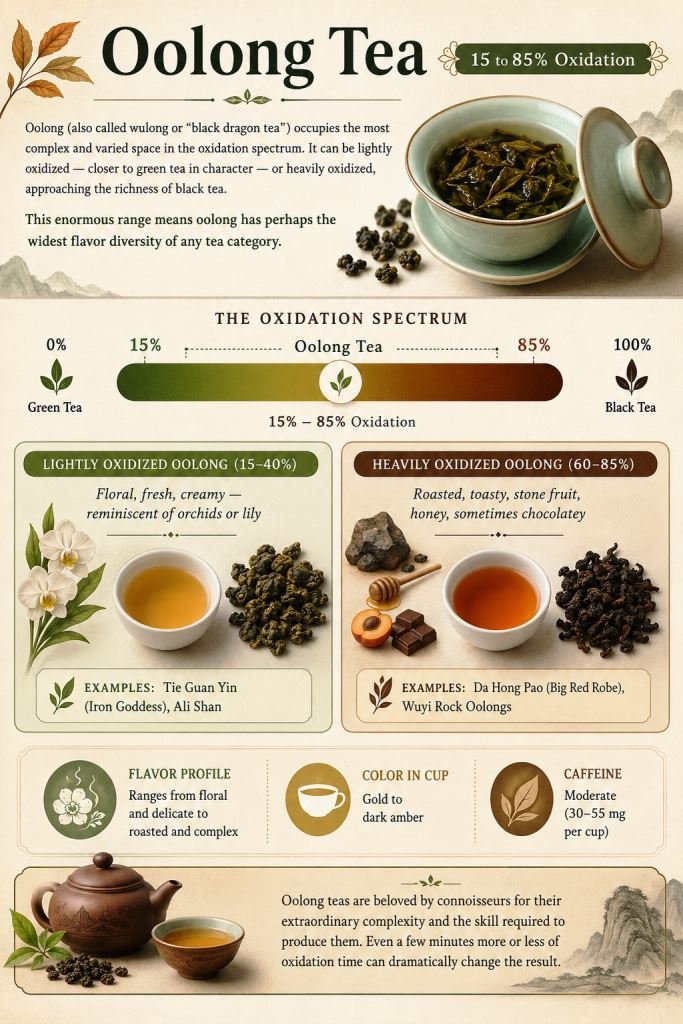
🍂 Oolong Tea — 15 to 85% Oxidation
Oolong (also called wulong or “black dragon tea”) occupies the most complex and varied space in the oxidation spectrum. It can be lightly oxidized — closer to green tea in character — or heavily oxidized, approaching the richness of black tea. This enormous range means oolong has perhaps the widest flavor diversity of any tea category.
Lightly oxidized oolong (15–40%):
Floral, fresh, creamy — reminiscent of orchids or lily
Examples: Tie Guan Yin (Iron Goddess), Ali Shan
Heavily oxidized oolong (60–85%):
Roasted, toasty, stone fruit, honey, sometimes chocolatey
Examples: Da Hong Pao (Big Red Robe), Wuyi Rock Oolongs
Flavor profile: Ranges from floral and delicate to roasted and complex
Color in cup: Gold to dark amber
Caffeine: Moderate (30–55 mg per cup)
Oolong teas are beloved by connoisseurs for their extraordinary complexity and the skill required to produce them. Even a few minutes more or less of oxidation time can dramatically change the result.
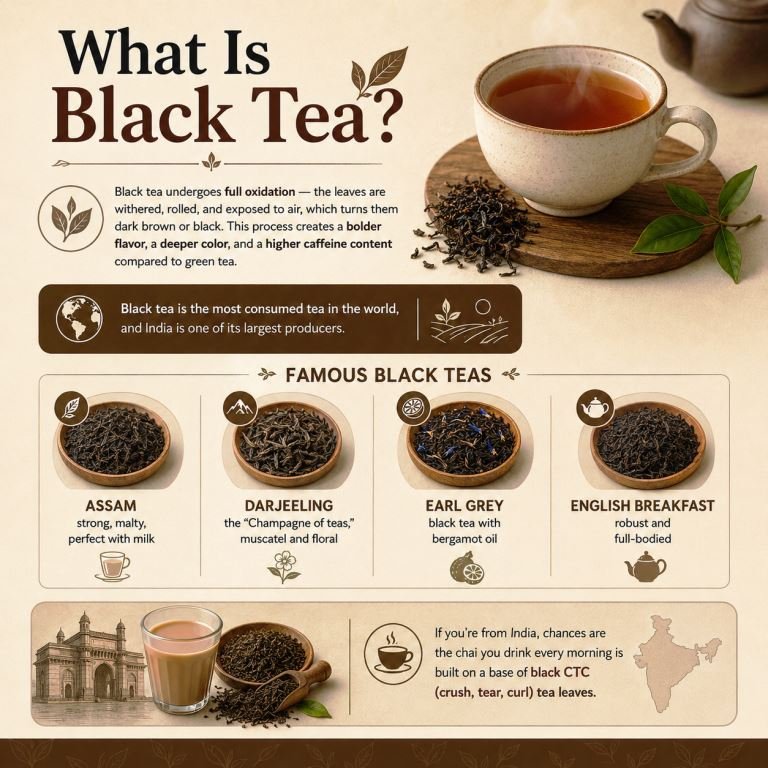
🍁 Black Tea — 90 to 100% Oxidation
Black tea undergoes full oxidation. After rolling, the leaves are spread out and allowed to oxidize completely — until the original green catechins have been almost entirely converted into theaflavins (bright, brisk, golden) and thearubigins (dark, mellow, deep).
The result is a bold, robust tea with a deep amber to dark brown color, rich malty or fruity flavors, and higher caffeine content.
Flavor profile: Malty, robust, earthy, sometimes fruity or floral depending on origin
Color in cup: Deep amber to dark brown
Caffeine: High (40–70 mg per cup)
Examples: Assam, Darjeeling (first and second flush), Ceylon, Earl Grey, English Breakfast, Keemun
In India, most everyday chai is built on CTC black tea — leaves that are crushed, torn, and curled for rapid, intense oxidation and a bold, milk-friendly brew.
🪨 Pu-erh Tea — Post-Fermented (Beyond Oxidation)
Pu-erh is unique. Raw Pu-erh (Sheng) undergoes slow, natural oxidation and microbial changes over years or decades of aging — developing extraordinary depth. Ripe Pu-erh (Shou) is artificially accelerated through a process called wet piling (wodui), using microbial fermentation to fast-track the aging.
This makes Pu-erh the only true post-fermented tea — where microorganisms play a significant role beyond enzymatic oxidation.
Flavor profile: Earthy, woody, mushroom-like, sometimes leather or dark chocolate in aged varieties
Color in cup: Very dark, almost black
Caffeine: Moderate to high
How Oxidation Changes the Chemistry of Tea
Understanding oxidation helps you understand what’s actually in your cup from a health perspective.
Catechins (Antioxidants in Green Tea)
Fresh tea leaves are rich in catechins — a family of potent antioxidants. The most studied is EGCG. These compounds are responsible for the anti-inflammatory, metabolism-boosting, and neuroprotective properties widely associated with green tea.
As oxidation progresses, catechins are enzymatically converted into new compounds — they don’t disappear; they transform.
Theaflavins (Antioxidants in Black Tea)
Theaflavins are the golden-orange pigments formed during oxidation. They give black tea its bright, brisk character and are responsible for the characteristic color you see around the rim of a cup of black tea. Theaflavins have their own impressive antioxidant and cardiovascular benefits.
Thearubigins (Color and Body in Black Tea)
Thearubigins are the large, complex polymers that form as oxidation progresses further. They give black tea its deep amber color and its full body. They comprise 60–70% of the dry weight of black tea solids and contribute to its mellow, smooth finish.
L-Theanine
This calming amino acid — responsible for green tea’s famous “calm alertness” effect — is present across all tea types but is highest in minimally processed teas. Shade-grown teas like Matcha and Gyokuro have particularly high L-theanine concentrations.
Caffeine
Contrary to popular belief, the caffeine content of tea does not significantly increase with oxidation. Caffeine is relatively stable and does not transform during oxidation. The higher caffeine in black tea compared to green is largely due to differences in leaf grade, brew time, water temperature, and steeping ratio — not oxidation itself.
The Role of the Tea Master: Controlling Oxidation
Producing fine tea — especially oolong — is as much art as science. Tea masters must judge exactly when to stop oxidation based on:
- Visual cues: The edges of the leaves bruise and turn reddish; the center remains green (classic for oolong)
- Aroma: The shift from grassy to floral signals the right moment
- Touch: The texture of the leaf changes as moisture decreases
- Experience: Generations of knowledge passed down through apprenticeship
A skilled tea maker can create dramatically different teas from the same batch of leaves simply by varying the oxidation time, temperature, and rolling intensity. This is the living craft at the heart of tea culture.
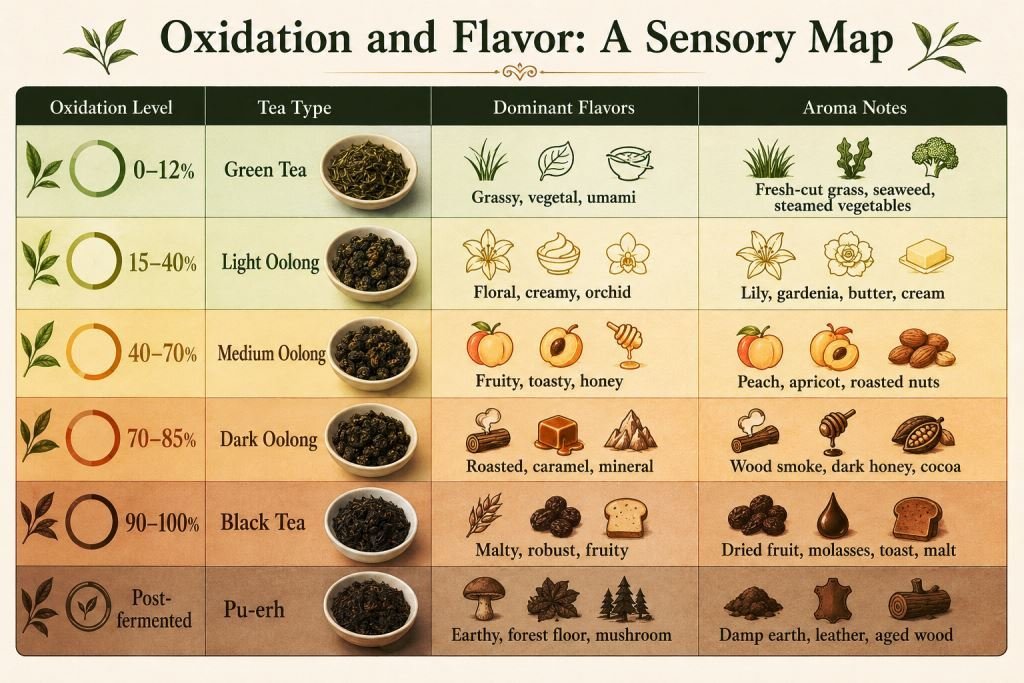
Oxidation and Flavor: A Sensory Map
| Oxidation Level | Tea Type | Dominant Flavors | Aroma Notes |
|---|---|---|---|
| 0–12% | Green Tea | Grassy, vegetal, umami | Fresh-cut grass, seaweed, steamed vegetables |
| 15–40% | Light Oolong | Floral, creamy, orchid | Lily, gardenia, butter, cream |
| 40–70% | Medium Oolong | Fruity, toasty, honey | Peach, apricot, roasted nuts |
| 70–85% | Dark Oolong | Roasted, caramel, mineral | Wood smoke, dark honey, cocoa |
| 90–100% | Black Tea | Malty, robust, fruity | Dried fruit, molasses, toast, malt |
| Post-fermented | Pu-erh | Earthy, forest floor, mushroom | Damp earth, leather, aged wood |
Common Questions About Tea Oxidation
Is oxidized tea less healthy than non-oxidized tea?
Not exactly. Green tea and black tea simply have different antioxidant profiles. Green tea is higher in catechins (especially EGCG), while black tea contains theaflavins and thearubigins — each with their own health benefits. Both are excellent choices.
Does oxidation affect caffeine content?
Not significantly. The differences in caffeine between tea types are more influenced by leaf grade, brew time, and preparation method than oxidation itself.
Q: What happens if tea is over-oxidized?
Over-oxidized tea becomes flat, dull, and lifeless — losing both its flavor complexity and its antioxidant potency. This is why controlling oxidation time is so critical in tea production.
Q: Is oolong tea oxidized or not?
Oolong is partially oxidized — anywhere from 15% to 85% depending on the style. This is precisely what gives oolong its extraordinary range and complexity.
Q: What is “green” oolong vs “dark” oolong?
Green oolongs (like Tie Guan Yin) are lightly oxidized and closer to green tea in character. Dark oolongs (like Da Hong Pao) are heavily oxidized and closer to black tea in depth and richness.
Q: Can I see oxidation happening at home?
Yes! Crush a fresh tea leaf between your fingers and leave it exposed to air for 20–30 minutes. The edges will start turning brownish — that’s polyphenol oxidase at work. This is the exact same process happening in a tea factory, just compressed into millions of leaves at once.
Why Understanding Oxidation Makes Tea More Meaningful
At Gelassen, our philosophy is rooted in the idea that slowing down brings depth. And there’s no better example of this than tea oxidation.
The tea maker who tends to a batch of oolong for hours — watching, smelling, adjusting — is practicing a form of radical presence. The result of that attention is a cup that carries all of that care forward, into your hands, into your morning.
When you understand that your cup of Darjeeling first flush is barely oxidized — delicate and floral, more like an oolong than a true black tea — you taste it differently. When you understand that your chai is built on fully oxidized leaves engineered to stand up boldly to milk and spice, you appreciate it more completely.
This is what mindful drinking means: not just consuming tea, but being in relationship with it.
A Quick Reference: Oxidation Levels of Popular Teas
| Tea | Oxidation Level |
|---|---|
| Silver Needle White Tea | ~5% |
| Japanese Sencha | ~8% |
| Chinese Dragon Well (Longjing) | ~10% |
| Matcha | ~5% |
| Yellow Tea | ~20–30% |
| Light Tie Guan Yin Oolong | ~20–30% |
| Traditional Tie Guan Yin | ~40–50% |
| Da Hong Pao (Rock Oolong) | ~70–80% |
| Darjeeling First Flush | ~30–40% |
| Assam Black Tea | ~95–100% |
| Ceylon Black Tea | ~90–100% |
| CTC Black Tea (Chai base) | ~100% |
| Raw Pu-erh (aged) | Variable + fermented |
Final Thoughts: One Plant, Infinite Possibilities
It is remarkable to think that every cup of tea — from the palest white tea to the darkest aged Pu-erh — comes from the same plant. The Camellia sinensis leaf, in the hands of a skilled producer and through the patient work of oxidation, becomes something entirely different each time.
Oxidation is not just chemistry. It is transformation. It is the same principle that turns a green hillside in Darjeeling into the copper of autumn, or a fresh grape into a complex aged wine. It is nature’s way of creating depth from simplicity.
Next time you brew a cup, take a moment to appreciate that process. The color in your cup, the aroma rising from the surface, the warmth wrapping around your hands — all of it arrived through a carefully guided natural transformation.
And that, perhaps, is the most gelassen thing of all: letting nature do its work, unhurried and deliberate, until something extraordinary emerges.
Explore more about tea culture, wellness, and mindful living at gelassen.in
Tags: oxidation of tea, tea processing, green tea, black tea, oolong tea, white tea, tea science, tea culture, wellness, mindful drinking, antioxidants, polyphenols, Camellia sinensis