How Is Darjeeling Tea Categorized? A Complete Guide to Flushes, Grades & Types
Published on Gelassen.in | Tea, Mindfulness & Mindful Living
Nestled in the foothills of the Himalayas, at elevations ranging from 600 to over 2,000 metres above sea level, lies one of the most celebrated tea-growing regions in the world: Darjeeling. The teas that come from this small district in West Bengal, India, are so distinctive and so prized that Darjeeling became the first Indian product to receive a Geographical Indication (GI) tag in 2004 — a recognition that, like Champagne or Parmigiano-Reggiano, a product’s character is inseparably tied to its place of origin.
But here is something that surprises many tea lovers: Darjeeling is not a single tea. It is a vast, nuanced category of teas — each defined by when it was harvested, how it was processed, where it grew, and how its leaves were graded. Understanding how Darjeeling tea is categorized is the key to unlocking one of the most complex and rewarding experiences in the world of tea.
At Gelassen, we believe that depth of understanding transforms the act of drinking into the art of savoring. So let us take you — unhurriedly — through every layer of Darjeeling tea’s remarkable classification system.
Part 1: The Foundation — What Makes a Tea “Darjeeling”?
Before we explore the categories, it is essential to understand what legally and geographically qualifies as Darjeeling tea.
The GI Tag and Its Meaning
Since 2004, only tea grown and produced within the Darjeeling district of West Bengal can be labeled and sold as “Darjeeling Tea.” The Tea Board of India enforces this through a certification mark — a distinctive Darjeeling logo that appears on authentic products.
The district encompasses 87 tea estates spread across three sub-divisions: Darjeeling, Kurseong, and Kalimpong. Each sub-division — and indeed, each individual estate — produces teas with subtly different character due to differences in altitude, slope, microclimate, and soil composition.
The annual production of certified Darjeeling tea is approximately 7–9 million kilograms — a modest quantity given global tea consumption, which contributes to its premium status.
The Camellia Sinensis Var. Sinensis Advantage
Most Indian black teas — particularly those from Assam — are made from Camellia sinensis var. assamica, a large-leafed plant bred for high-volume, bold-flavored production.
Darjeeling’s finest teas, however, are largely grown from China-origin plants (Camellia sinensis var. sinensis) — smaller-leafed, slower-growing, and more sensitive to environmental conditions. These plants, introduced to the region by British planters in the mid-19th century, are the foundation of Darjeeling’s legendary delicacy and complexity.
The cool temperatures, high altitude, mist, and the famous “rain shadow” weather patterns of the Himalayas slow the growth of these plants dramatically — forcing the leaf to develop concentrated flavors and aromatic compounds that simply cannot be replicated elsewhere.
Part 2: Categorization by Flush — The Most Important Classification
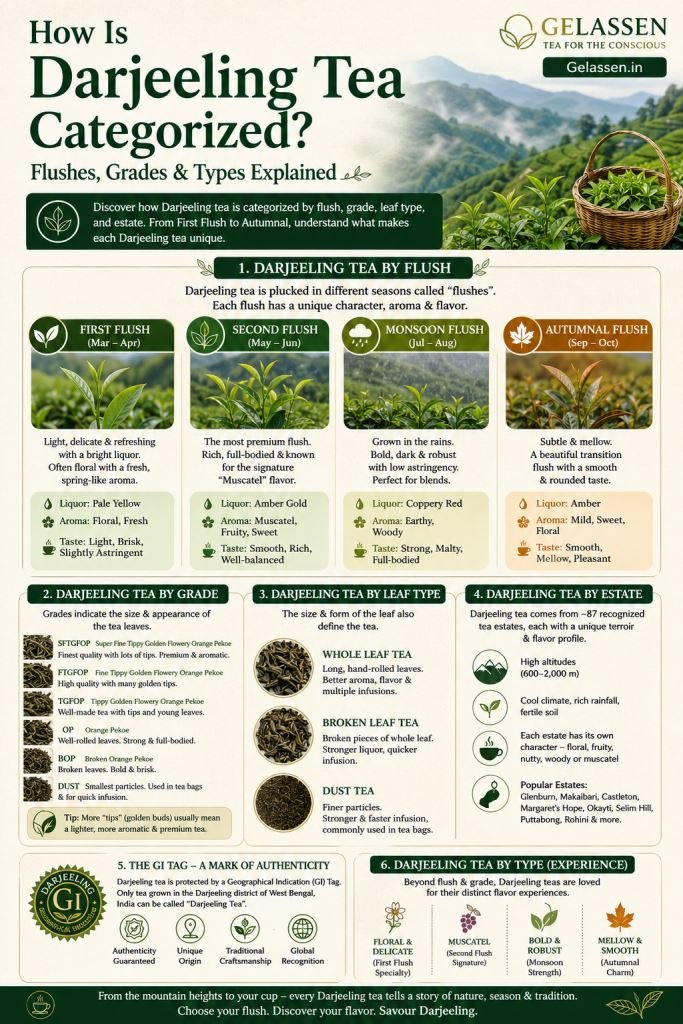
The single most important way Darjeeling tea is categorized is by flush — the seasonal harvest cycle. Each flush corresponds to a specific time of year and produces tea with a dramatically different character.
There are four primary flushes in Darjeeling:
🌱 First Flush — The Spring Awakening (March to April)
The first flush marks the beginning of the tea-growing season after the long winter dormancy. As temperatures rise and the first spring rains arrive, the tea bushes wake up and produce their first tender new shoots.
Harvest window: Mid-March to late April
Also known as: Spring flush, “the new season tea”
What Makes First Flush Unique
After months of dormancy, the plants have accumulated nutrients and energy. The new buds and leaves that emerge are exceptionally tender, delicate, and packed with aromatic compounds — particularly linalool and geraniol, which contribute to the distinctive floral and citrusy notes.
First flush teas are typically processed with minimal oxidation — often closer to a light oolong or even a green tea in character, despite being technically categorized as black tea by the Tea Board. Many modern estates are deliberately keeping oxidation at 30–50% to preserve the vibrant freshness of the spring leaves.
Flavor & Aroma Profile
- Color in cup: Pale gold to soft amber — almost like a white wine
- Aroma: Highly floral — orchid, jasmine, rose, sometimes a light muscatel
- Flavor: Delicate, bright, slightly astringent, vegetal, with a characteristic “greenish” freshness
- Finish: Clean, refreshing, lingering floral
Who Should Drink First Flush?
First flush is ideal for those who prefer light, aromatic, nuanced teas — those who enjoy Japanese green teas or light oolongs will likely love first flush Darjeeling. It should always be brewed without milk, as milk would overwhelm its delicate character.
It is the most eagerly anticipated harvest of the year. Premium first flush teas can command extraordinary prices at auction — sometimes exceeding the cost of fine wine per kilogram.
☀️ Second Flush — The Golden Standard (May to June)
If first flush is Darjeeling’s spring awakening, second flush is its golden summer masterpiece — the harvest that has made Darjeeling famous worldwide and earned it the title “the Champagne of teas.”
Harvest window: May to mid-June
Also known as: Summer flush
What Makes Second Flush Unique
By the time of the second flush, the tea plants are in full growth. The temperatures are warmer, the humidity has risen, and the leaves have had additional time to mature. The combination of longer days, increased warmth, and specific atmospheric conditions in Darjeeling’s Himalayan valleys triggers the development of the compound that defines second flush Darjeeling: 2-acetyl-1-pyrroline — the molecule responsible for the famous muscatel character.
Muscatel is one of the most celebrated and distinctive flavor notes in all of tea — a warm, grape-like, almost wine-like sweetness, often compared to Muscat wine grapes or sun-dried raisins.
The Role of the Leafhopper Insect
Remarkably, the muscatel character of second flush Darjeeling is partly attributed to the activity of a tiny insect: the green leafhopper (Jacobiasca formosana). When this insect feeds on the tea leaves, it triggers a defensive chemical response in the plant — producing terpenoids and other aromatic compounds that intensify the muscatel note. The finest second flush teas often come from estates where leafhopper activity is highest.
This is the same phenomenon behind Taiwan’s famous Oriental Beauty oolong, where the same insect interaction creates a similar honey-sweet character.
Flavor & Aroma Profile
- Color in cup: Deep amber, copper-gold — rich and luminous
- Aroma: Muscatel (grape, wine, raisin), full, heady, sometimes hints of peach, apricot, or spice
- Flavor: Full-bodied, round, less astringent than first flush, complex and layered
- Finish: Long, warm, wine-like, with a characteristic lingering sweetness
Who Should Drink Second Flush?
Second flush is the quintessential Darjeeling experience — the tea that best represents why this region is so revered. It is excellent plain or with a small amount of milk. It can stand up to stronger brewing and pairs beautifully with afternoon sweets, light pastries, or simply with contemplative silence.
🌧️ Monsoon Flush — The Rain Harvest (July to September)
As the monsoon season descends on the Himalayas, the tea plants enter a period of rapid, vigorous growth driven by abundant rainfall. The monsoon flush — also called the “rainy flush” — is harvested during this period.
Harvest window: July to September
Also known as: Rains flush, monsoon tea
What Makes Monsoon Flush Unique
The heavy rainfall and high humidity cause the tea plants to grow very quickly — faster than at any other time of year. While this produces a high volume of leaves, the rapid growth also means the leaves are less concentrated in flavor compounds, more watery, and less complex than first or second flush teas.
Monsoon flush teas are fully oxidized (true black teas) and produce a strong, full-bodied brew. They are darker, more tannic, and less nuanced than the spring and summer harvests.
Flavor & Aroma Profile
- Color in cup: Dark amber to brown — robust and full
- Aroma: Earthy, woody, malty, straightforward
- Flavor: Bold, strong, slightly harsh, less complex
- Finish: Quick, with lingering tannins
Use & Value
Monsoon flush teas are generally the most affordable Darjeeling teas and are well-suited for:
- Blending into Darjeeling-based chai
- Preparation with milk and spices
- Use in iced tea
- Everyday drinking where cost is a consideration
Many tea blenders purchase monsoon flush Darjeeling specifically for its body and strength, blending it with more aromatic first or second flush teas to create balanced, accessible products.
🍂 Autumnal Flush — The Quiet Finale (October to November)
After the monsoon recedes and the autumn calm settles over the Himalayas, the tea plants produce their final harvest of the year — the autumnal flush. This is a quieter, gentler harvest, often overlooked in favor of the more celebrated spring and summer teas, but increasingly appreciated by connoisseurs.
Harvest window: October to November
Also known as: Autumn flush, fall flush
What Makes Autumnal Flush Unique
The post-monsoon period brings cooler temperatures, lower humidity, and clear Himalayan skies. The tea plants, having recovered from the vigorous monsoon growth, slow down and produce leaves with a different character from any other flush.
Autumnal Darjeeling is fully oxidized — a true black tea — but with a distinctive roundness and depth that sets it apart from the monsoon flush. The cooler conditions concentrate flavors gently, and the resulting teas often have a warm, nutty, slightly woody character with a smoothness that the more tannic monsoon teas lack.
Flavor & Aroma Profile
- Color in cup: Rich amber to deep copper
- Aroma: Warm, woody, nutty, sometimes hints of dried fruit or spice
- Flavor: Full-bodied, smooth, less floral than first flush, less muscatel than second flush, but with its own quiet complexity
- Finish: Smooth, warming, long
Who Should Drink Autumnal Flush?
Autumnal flush is gaining a loyal following among those who want the approachability and body of a black tea without the sharpness of the monsoon flush, and who are not chasing the dramatic floral or muscatel characters of the spring and summer. It pairs well with milk, is excellent for warming autumn and winter mornings, and represents excellent value for its quality.
The Four Flushes at a Glance
| Flush | Season | Oxidation | Flavor | Character | Price Range |
|---|---|---|---|---|---|
| First Flush | March–April | Low–Medium (30–60%) | Floral, light, fresh | Delicate, spring-like | Premium to very premium |
| Second Flush | May–June | Medium–High (60–80%) | Muscatel, fruity, complex | Rich, wine-like | Premium |
| Monsoon Flush | July–September | Full (90–100%) | Bold, earthy, malty | Strong, straightforward | Affordable |
| Autumnal Flush | October–November | Full (90–100%) | Nutty, woody, smooth | Round, warming | Moderate |
Part 3: Categorization by Leaf Grade — Understanding the Alphabet of Tea
After the harvest is processed, Darjeeling teas are sorted and classified using a grading system based on the size, condition, and composition of the dried leaves. These grades appear on tea packaging as a series of letters — and understanding them helps you know exactly what’s in your tin.
The grading system does not indicate flavor quality directly, but it does tell you about the leaf composition and how the tea will brew.
The Whole Leaf Grades
These grades represent the most intact, carefully processed leaves — generally associated with the finest quality teas.
FTGFOP1 — Finest Tippy Golden Flowery Orange Pekoe, Grade 1
The highest standard grade for Darjeeling. This is the crème de la crème of whole-leaf classification.
- FT — Finest: exceptional quality standard
- G — Golden: the presence of golden-tipped buds (tips oxidize to a golden color)
- F — Flowery: abundance of the tender young buds called “tips” or “orange tips”
- OP — Orange Pekoe: a full, intact leaf grade (the name “orange” is historical, referring to the Dutch House of Orange, not the fruit)
- 1 — Grade 1: the highest within the FTGFOP category
Tea lovers sometimes joke that FTGFOP1 stands for “Far Too Good For Ordinary People” — a testament to how highly it is regarded.
Appearance: Long, twisted, elegant leaves with abundant golden and silver tips
Brew: Complex, nuanced, highly aromatic
Best for: First and second flush Darjeeling, specialty and estate teas
TGFOP1 — Tippy Golden Flowery Orange Pekoe, Grade 1
One step below FTGFOP1, but still an exceptional whole-leaf grade with significant tip content.
TGFOP — Tippy Golden Flowery Orange Pekoe
Same as TGFOP1 but without the grade 1 designation. Still a premium whole-leaf tea with good tip content.
GFOP — Golden Flowery Orange Pekoe
Whole leaf with golden tips, but less abundant in tips than TGFOP grades.
FOP — Flowery Orange Pekoe
A good whole-leaf grade with some tip content. The base of many quality Darjeeling blends.
OP — Orange Pekoe
Whole leaf, minimal tips. A clean, consistent grade widely used in quality black tea production.
The Broken Leaf Grades
These grades are made from leaves that have been deliberately broken during processing, producing smaller pieces that brew faster and more intensely.
FTGBOP1 — Finest Tippy Golden Broken Orange Pekoe, Grade 1
The premium broken grade — smaller than FTGFOP1 but retaining tip content and quality.
TGBOP — Tippy Golden Broken Orange Pekoe
A good broken grade with tip content. Brews into a full, flavorful cup relatively quickly.
GBOP — Golden Broken Orange Pekoe
A standard broken grade with some golden tips.
BOP — Broken Orange Pekoe
The most common broken grade — produces a strong, consistent cup. Used widely in blending.
The Fannings and Dust Grades
These are the smallest particles produced during processing and sorting.
BOPF — Broken Orange Pekoe Fannings
Very fine particles that brew extremely fast and produce a very strong, dark cup. Used primarily in tea bags.
Dust
The finest siftings from production. Produces the strongest, fastest-brewing cup. Used in economy tea bag blends.
A Note on Grade vs. Quality
It is important to understand that grade is not a direct measure of quality — it is a description of leaf size and composition. An FTGFOP1 first flush from a prestigious estate will naturally be extraordinary, but a well-processed BOP from the same estate at the right flush can also be genuinely excellent and far more affordable.
Many experienced tea drinkers prefer certain broken grades because they produce a consistently strong, satisfying cup — especially when drinking with milk.
Part 4: Categorization by Processing Style
Beyond flush and grade, Darjeeling teas are also categorized by how they are processed — particularly the level of oxidation applied.
Orthodox Processing
The traditional method for producing whole-leaf Darjeeling tea is called orthodox processing. In this method:
- Leaves are withered on racks for 12–18 hours
- They are hand-rolled or gently machine-rolled to bruise the cells
- They are allowed to oxidize at controlled temperatures and humidity
- They are fired to halt oxidation and dry the leaf
Orthodox processing preserves the complexity, aroma, and nuance of the tea leaf — it is the method behind the finest first and second flush Darjeeling teas. The resulting leaves are whole, twisted, and elegant.
CTC Processing
CTC (Crush, Tear, Curl) is an industrial process in which leaves are passed through cylindrical rollers with sharp teeth that crush, tear, and curl them into tiny uniform pellets. The result is rapid, intense oxidation and a bold, consistent, fast-brewing tea.
While most premium Darjeeling is orthodox-processed, some estates also produce CTC teas — primarily for the domestic Indian market where a strong, milk-friendly brew is preferred.
CTC Darjeeling lacks the complexity of orthodox teas but offers consistency and affordability.
Green and White Darjeeling
A small but growing category of Darjeeling teas are produced as green tea (no oxidation) or white tea (minimal processing). These are increasingly popular among health-conscious consumers and tea enthusiasts who want Darjeeling’s unique terroir expressed in a lighter, more antioxidant-rich format.
Darjeeling green teas are particularly interesting — the terroir of the Himalayas gives them a character quite different from Chinese or Japanese green teas, often more floral and mineral.
Oolong-Style Darjeeling
Some forward-thinking Darjeeling estates are deliberately producing oolong-style teas — partially oxidized (30–60%) and crafted with techniques borrowed from Taiwanese and Chinese oolong traditions. These teas occupy a fascinating middle ground and often exhibit extraordinary floral and honeyed complexity.
Many “first flush” Darjeeling teas, with their lighter oxidation, already approach oolong territory — and some producers are explicitly marketing them as such.
Part 5: Categorization by Estate (Origin)
The concept of terroir — the idea that a product’s character reflects the specific land, climate, and altitude where it was grown — is as relevant to Darjeeling tea as it is to fine wine.
The 87 gardens in Darjeeling each produce teas with a recognizable and distinct character. Some of the most celebrated estates include:
Makaibari Tea Estate
Founded in 1859, Makaibari is one of the oldest and most famous tea estates in the world. Located at 1,500–2,400 metres, it was a pioneer of biodynamic and organic tea farming. Makaibari’s teas — particularly their silver tips and muscatel second flush — are legendary, with single-estate lots fetching extraordinary prices at auction.
Castleton Tea Estate
Castleton, in the Kurseong sub-division, is renowned for producing some of the finest second flush muscatel teas in Darjeeling. Its name is synonymous with the very best expression of the muscatel character — full, wine-like, and unforgettable.
Thurbo Tea Estate
Situated at high altitude in the Mirik Valley, Thurbo produces exceptional first flush teas — some of the most floral and delicate in the region. Their high-elevation gardens experience extreme weather variation that concentrates flavors beautifully.
Goomtee Tea Estate
Located in the Kurseong region, Goomtee is celebrated for its consistent quality across flushes and its beautiful, tippy whole-leaf grades. A reliable benchmark for classic Darjeeling character.
Jungpana Tea Estate
A smaller, boutique estate perched at very high altitude, Jungpana is known for intensely aromatic, exceptionally complex teas — particularly muscatel second flush offerings that are sought after by collectors worldwide.
Namring Tea Estate
One of Darjeeling’s higher-altitude gardens, Namring produces teas with distinctive mineral clarity and floral depth. Their first flush teas are particularly prized for their bright, clean character.
How Estate, Altitude, and Microclimate Interact
| Factor | Effect on Tea Character |
|---|---|
| Higher altitude | Slower growth, more concentrated flavors, more delicate and complex |
| Lower altitude | Faster growth, bolder, more robust character |
| Eastern slopes | More morning sun, often more floral and bright |
| Western slopes | More afternoon sun, often fuller and warmer |
| Clay-rich soils | More mineral, earthy undertones |
| Well-drained rocky soils | More delicate, refined character |
Part 6: Categorization by Certification and Farming Practice
Increasingly, Darjeeling teas are also categorized and marketed according to their farming and certification standards — a reflection of growing consumer interest in sustainability and health.
Organic Darjeeling
A significant and growing number of Darjeeling estates have converted to certified organic farming, avoiding synthetic pesticides and fertilizers. Organic Darjeeling carries certifications from bodies like IMO (Institute for Marketecology), USDA Organic, or EU Organic.
Makaibari pioneered this movement decades ago, and today estates like Thurbo, Ambootia, and Rohini are well-known for their organic programs.
Biodynamic Darjeeling
A step beyond organic, biodynamic farming treats the entire farm as a living ecosystem, following a planting calendar based on lunar cycles and using holistic, closed-loop agricultural practices. Makaibari is the most celebrated biodynamic estate in Darjeeling.
Rainforest Alliance and Fairtrade
Some estates carry Rainforest Alliance or Fairtrade certifications, indicating adherence to standards around environmental sustainability, worker welfare, and community development.
Part 7: Reading a Darjeeling Tea Label — Putting It All Together
When you purchase a quality Darjeeling tea, the label may contain a remarkable amount of information. Here’s how to decode it:
Example label: Makaibari Estate | First Flush 2024 | FTGFOP1 | Organic | DJ-1
| Label Element | What It Tells You |
|---|---|
| Makaibari Estate | The specific garden — terroir, farming practices, reputation |
| First Flush 2024 | Harvested March–April 2024 — delicate, floral, light |
| FTGFOP1 | Finest whole-leaf grade with abundant golden tips |
| Organic | Grown without synthetic inputs, certified organic |
| DJ-1 | DJ = Darjeeling (the GI mark identifier); the number indicates the specific lot |
The DJ number (Darjeeling lot number) is particularly important for connoisseurs — it identifies the precise batch and is assigned by the Tea Board of India, ensuring traceability and authenticity.
Part 8: Common Misconceptions About Darjeeling Tea
“Darjeeling tea is always black tea”
False. While most Darjeeling tea is processed as black or partially oxidized, Darjeeling is also produced as green tea, white tea, and oolong. The first flush, in particular, often has minimal oxidation that technically makes it closer to a light oolong.
“All Darjeeling tastes the same”
Significantly false. A first flush FTGFOP1 from Jungpana and a monsoon flush BOP from a lower-altitude garden are worlds apart in character — as different as a Sancerre and a Rioja.
“The higher the grade, the better the tea”
Not necessarily. Grade indicates leaf size and composition, not absolute quality. A beautiful, well-made BOP second flush can be more enjoyable than a carelessly processed FTGFOP1.
“Darjeeling tea always has a muscatel flavor”
Only second flush Darjeeling — and specifically the better second flush teas — develop true muscatel character. First flush, monsoon, and autumnal teas have entirely different flavor profiles.
“Darjeeling tea should be brewed like regular black tea”
First flush Darjeeling in particular should be brewed at lower temperatures (85–90°C, not boiling) and for shorter times (2–3 minutes) to preserve its delicate aromatics. Treating it like Assam will result in a bitter, astringent cup.
Brewing Guide by Flush
| Flush | Water Temperature | Steep Time | Milk? | Notes |
|---|---|---|---|---|
| First Flush | 85–90°C | 2–3 minutes | No | Use filtered water; don’t overbrew |
| Second Flush | 90–95°C | 3–4 minutes | Optional, small amount | Best plain to appreciate muscatel |
| Monsoon Flush | 95–100°C | 4–5 minutes | Yes | Works well in chai preparations |
| Autumnal Flush | 90–95°C | 3–4 minutes | Optional | Versatile; good everyday tea |
The Gelassen Perspective: Darjeeling as a Practice of Presence
Understanding the classification of Darjeeling tea is not about becoming an expert or impressing others at a dinner party. It is about something quieter and more personal: learning to pay attention.
When you know that your first flush Darjeeling was harvested from plants that had been dormant all winter — that its delicacy is the result of slow growth, precise timing, and the careful hands of a skilled tea maker — you bring something different to the act of drinking it. Attention. Appreciation. Presence.
This is the spirit of Gelassen: not rushing past the cup in your hand, but settling into it. Letting the first flush teach you what spring tastes like in the Himalayas. Letting the second flush show you what warm, unhurried summer afternoons smell like at 2,000 metres.
Tea, at its finest, is a geography of the senses. Darjeeling is one of its most eloquent languages.
Frequently Asked Questions
Q: How many flushes does Darjeeling tea have?
Darjeeling has four primary flushes: first flush (spring), second flush (summer), monsoon flush (rainy season), and autumnal flush (autumn). The first and second flushes are the most prized.
Q: What is the best Darjeeling tea flush to buy?
It depends on what you enjoy. For delicate, floral, light tea — first flush. For full-bodied, muscatel, complex tea — second flush. For strong, everyday drinking — monsoon or autumnal flush.
Q: What does “muscatel” mean in Darjeeling tea?
Muscatel refers to a warm, grape-like, wine-like aroma and flavor — reminiscent of Muscat wine grapes or sun-dried raisins. It is the signature character of fine second flush Darjeeling and is partly caused by the feeding of the green leafhopper insect on the tea leaves.
Q: What does FTGFOP1 mean on Darjeeling tea packaging?
It stands for Finest Tippy Golden Flowery Orange Pekoe, Grade 1. It indicates the highest grade of whole-leaf Darjeeling tea with abundant golden tips. It describes the leaf composition, not an absolute quality rating.
Q: Is Darjeeling tea caffeinated?
Yes. Darjeeling tea contains caffeine, though the level varies by flush and processing. First flush tends to be lower in caffeine due to lighter oxidation; second and monsoon flush teas are higher.
Q: What is the GI tag for Darjeeling tea?
Darjeeling tea received India’s first Geographical Indication (GI) tag in 2004, meaning only tea grown and produced within the Darjeeling district of West Bengal can legally be sold as “Darjeeling Tea.”
Q: Can I drink Darjeeling tea with milk?
First flush is best enjoyed without milk to appreciate its delicate floral character. Second flush can be enjoyed with or without a small amount of milk. Monsoon and autumnal flushes hold up well with milk.
Final Thoughts: One Region, Infinite Dimensions
Darjeeling tea is a category that rewards the curious and the patient. The same small hillside district — just 26 kilometres from north to south — produces teas that range from pale, floral, nearly-green spring harvests to rich, muscatel-laced amber summer brews, and from bold monsoon teas to quietly complex autumn cups.
This richness does not happen by accident. It is the result of extraordinary terroir, centuries of agricultural knowledge, the rhythm of the Himalayan seasons, and the skilled hands of the women and men who tend these gardens and craft these leaves every day.
Understanding how Darjeeling tea is categorized — by flush, by grade, by processing style, by estate, by certification — does not complicate your enjoyment. It deepens it.
And deepening the experience of something beautiful is, ultimately, what the gelassen life is all about.
Explore more about tea culture, wellness, and mindful living at gelassen.in
Tags: Darjeeling tea, first flush, second flush, monsoon flush, autumnal flush, tea grades, FTGFOP1, muscatel, GI tag, tea estates, orthodox tea, tea categorization, Himalayan tea, West Bengal tea, tea culture