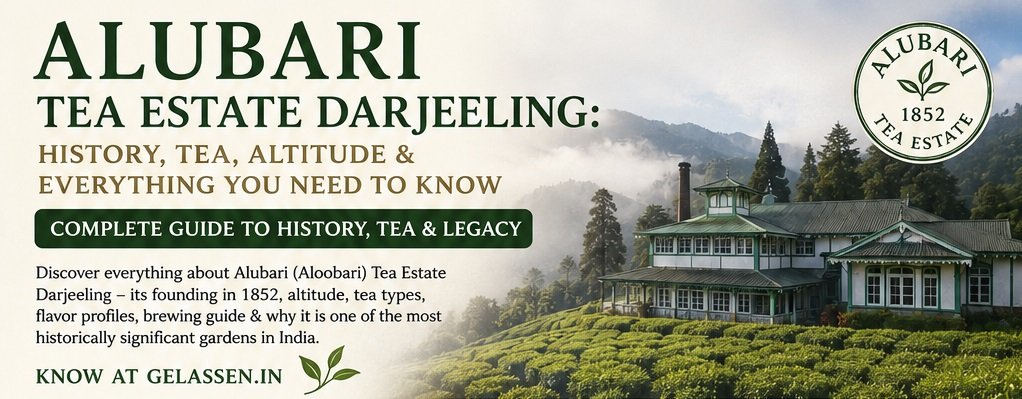
Published on Gelassen.in | Tea, Mindfulness & Mindful Living
There are tea estates that produce remarkable teas. There are estates that offer breathtaking views. And then there are a very rare few that carry something beyond quality and beauty — estates that carry history itself in their soil, their slopes, and the very story of how they came to be.
Alubari Tea Estate — also written as Aloobari — is one of those few.
Established in the mid-19th century during the earliest days of Darjeeling’s tea industry, Alubari is among the founding tea gardens of India. It is one of the original three commercial tea estates from which Darjeeling’s entire legendary tea tradition grew. To understand Alubari is to understand where Darjeeling tea — the “Champagne of teas” — truly began.
In this detailed guide, we explore every dimension of Alubari Tea Estate: its origin and meaning, its geography and altitude, its founding figures, its teas and flavor profile, its place in Darjeeling’s history, and why this quiet, historic hillside garden deserves a far larger place in every tea lover’s awareness.
At Gelassen, we believe that the history in your cup is as nourishing as the tea itself. So let us begin — unhurriedly, as all good things should.
What Does “Alubari” Mean?
Before a single leaf was plucked, the land that would become one of India’s most historically significant tea estates had a far humbler identity.
“Alubari” is a Bengali and Nepali compound word:
- Alu (আলু) — potato
- Bari (বাড়ি / বারি) — field, garden, or homestead
Literally translated, Alubari means “potato field.”
This name tells us something beautiful and grounding about the estate’s origins. Before tea arrived in Darjeeling, this hillside was agricultural land — farmed by local communities growing potatoes, one of the primary crops of the Himalayan highlands. The transformation of a humble potato patch into one of the world’s most celebrated tea-growing sites is one of the quietly remarkable stories of Indian agricultural history.
The name has survived through generations, sometimes spelled Aloobari — a phonetic variation of the same word. Both spellings refer to the same estate, the same history, and the same terroir.
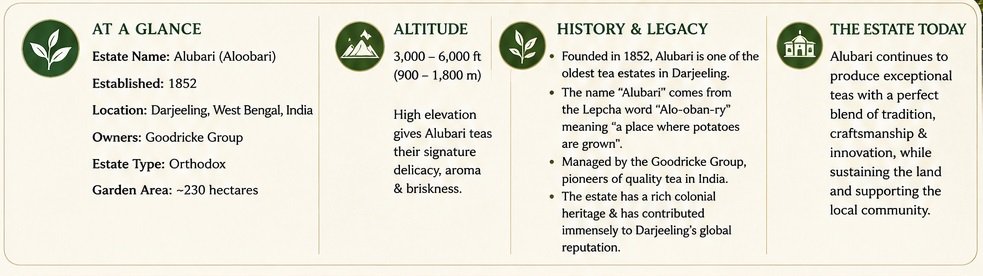
Quick Reference: Alubari Tea Estate at a Glance
| Detail | Information |
|---|---|
| Full Name | Alubari Tea Estate (also: Aloobari Tea Estate) |
| Established | 1852–1856 (among Darjeeling’s first three commercial tea gardens) |
| Location | Darjeeling Pulbazar area, Darjeeling district, West Bengal, India |
| Sub-Division | Darjeeling Sadar |
| Altitude | Approximately 2,300 metres (7,545 ft) above sea level |
| Direction from Town | North-east of Darjeeling town |
| Distance from Town | Approximately 5–11 km |
| Founding Company | Kurseong and Darjeeling Tea Company |
| Founding Figure | Captain Samler |
| Historical Significance | One of Darjeeling’s three original commercial tea gardens |
| Tea Types Produced | Black (First Flush, Second Flush), Green, White |
| Certification | Eco-friendly / quality-compliant practices |
| GI Tag | Certified Darjeeling Tea (Tea Board of India) |
Part 1: The Historical Context — How Darjeeling Tea Began
To understand Alubari’s significance, we must step back to the beginning of Darjeeling’s entire tea story.
Dr. Archibald Campbell and the First Tea Plants
The story of tea in Darjeeling begins not with a business decision, but with a scientist’s curiosity. Dr. Archibald Campbell, a civil surgeon of the Indian Medical Service, was transferred to Darjeeling as its Superintendent in 1839 — arriving in a region where barely 20 families lived across the entire Himalayan hill tract.
In 1841, Dr. Campbell brought seeds of the Chinese tea plant (Camellia sinensis var. sinensis) from the Kumaon Hills and began planting them experimentally in his personal garden in Darjeeling. The results were quietly extraordinary. The cool temperatures, high altitude, mist-laden slopes, and well-drained Himalayan soil proved to be ideal — in some ways remarkably similar to the tea-growing highlands of Yunnan and Fujian in China where these very plants originated.
Campbell’s success demonstrated something the world had not yet proven: that the finest varieties of Chinese tea plants could thrive in the Indian Himalayas.
The Government Steps In: 1847
Encouraged by Campbell’s results, the British colonial government formally decided to encourage commercial tea production in Darjeeling in 1847. Land was offered on favorable terms, with one important condition: of every forested plot allotted for tea cultivation, only 40% could be cleared for planting — the remaining 60% had to remain as natural forest. This early conservation policy, though colonial in origin, shaped Darjeeling’s landscape in ways that persist to this day.
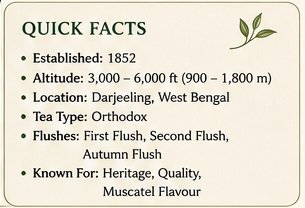
The Founding Three Gardens: 1852
Commercial development began in earnest in 1852, when the first three experimental tea gardens were established from seeds sourced from government nurseries:
- Tukvar (now Puttabong Tea Estate)
- Steinthal
- Alubari (Aloobari)
These three estates were the genesis of the entire Darjeeling tea industry. Everything that came after — the 87 certified estates, the GI tag, the first flush auctions, the muscatel second flush that has captivated connoisseurs for 170 years — traces its roots to these three hillsides.
Alubari was one of the founding three. That fact alone gives it a historical weight that no subsequent achievement can replicate.
Part 2: Captain Samler and the Founding of Alubari
Who Was Captain Samler?
Captain Samler is one of the most important — and least celebrated — figures in the history of Indian tea. A British military officer who had retired from active service, Samler became an agent of the Kurseong and Darjeeling Tea Company — the colonial enterprise that managed the earliest commercial tea cultivation in the Darjeeling hills.
Samler had served as an officer of the British East India Company, which had acquired portions of Darjeeling from the Kingdoms of Nepal and Sikkim following the Treaty of Titaliya (1815) and a subsequent Deed of Grant (1835). He was one of the earliest European settlers to see the agricultural potential of these Himalayan slopes.
Samler and Makaibari
Samler is historically associated with two of Darjeeling’s founding estates. He began planting Chinese tea plants on the rocky soil of Kurseong where Makaibari now stands — making him one of Makaibari’s earliest founding figures. He was later formally appointed as the agent and legal owner of Makaibari in 1859.
The Founding of Alubari: 1852–1856
Historical records — including the Darjeeling Gazetteer, one of the primary colonial-era documents on the district — attribute the establishment of the Alubari tea garden to Captain Samler, under the management of the Kurseong and Darjeeling Tea Company.
Different historical accounts place the formal establishment of Alubari between 1852 and 1856. Some sources cite 1852 as the year the experimental nursery seeds were planted (alongside Tukvar and Steinthal), while the Darjeeling Gazetteer records 1856 as the year Alubari was formally opened as a commercial garden. This discrepancy reflects the gradual, staged nature of establishing a tea estate — planting, waiting for the bushes to mature, building the factory, and beginning commercial production all happened over several years. <aside> “Captain Samler was the first tea planter who started the Alubari tea garden in 1856 under the management of Kurseong and Darjeeling Tea Company.” — Darjeeling Gazetteer, as cited in historical records of Darjeeling’s tea plantation history </aside>
What is unambiguous is that Alubari was among the very first commercial tea plantations established in Darjeeling — a founding member of an industry that would transform the Himalayan hills and eventually come to define India’s global reputation in fine tea.
The Significance of the Kurseong and Darjeeling Tea Company
The Kurseong and Darjeeling Tea Company was the colonial-era commercial entity responsible for the early development of tea cultivation in the district. It operated several experimental and early commercial gardens simultaneously, using seeds from the government nurseries established under Dr. Campbell’s initiative. Alubari was one of its flagship early projects — a living proof-of-concept that high-altitude Himalayan hillsides could produce extraordinary tea.
Part 3: Geography and Terroir — The Land of Alubari
Location
Alubari Tea Estate is situated in the north-eastern area of Darjeeling, within the Darjeeling Pulbazar sub-division of Darjeeling Sadar. The estate lies approximately 5 to 11 kilometres from Darjeeling town — close enough to the hill station to have been accessible to early colonial management, yet high enough to benefit from Darjeeling’s signature mountain climate.
The village and tea garden community associated with Alubari falls within the Darjeeling Pulbazar Block and is administered under the Darjeeling II Gram Panchayat. The pincode of the area is 734102.
Altitude: 2,300 Metres Above Sea Level
One of the most defining characteristics of Alubari Tea Estate is its altitude of approximately 2,300 metres (roughly 7,545 feet) above sea level. This places it among the higher-altitude tea gardens in Darjeeling — a distinction that is directly and profoundly reflected in the character of its teas.
At this elevation:
- Air is cooler and thinner, slowing the metabolism of the tea plant and forcing it to develop flavor compounds more slowly and concentratedly
- Mist is almost constant in the morning and evening for most of the year, creating high ambient humidity that the tea plant loves
- UV radiation is higher, which stimulates the production of polyphenols and antioxidants in the leaf as a natural protective response
- Temperature fluctuations between day and night are dramatic — warm, sun-filled afternoons contrast with cold mountain nights, slowing growth further and concentrating flavors
- Rainfall is abundant but well-distributed across the growing season, with the monsoon providing deep moisture that the well-drained Himalayan soil regulates naturally
This combination — cool, misty, high-altitude, well-drained, and sun-touched — is the terroir that defines great Darjeeling tea. And at 2,300 metres, Alubari sits squarely within it.
Soil and Landscape
The soils of the Darjeeling hills are primarily loamy and rocky Himalayan substrates — acidic, well-drained, and rich in minerals leached from the mountain rock. These soil conditions are ideal for tea cultivation, which prefers acidic, well-drained soil that does not waterlog.
The estate’s hillside terrain is characteristic of Darjeeling’s landscape: steep slopes with good natural drainage, facing into the valley below, with forest cover on the upper reaches. This topography ensures that even during the intense monsoon rainfall of July and August, the tea bushes are never waterlogged — a critical condition for maintaining the health and flavor quality of the plant.
Mist and the “Darjeeling Effect”
The cool mountain air of the Darjeeling hills creates a consistent pattern of morning mist — a thin, cool fog that settles over the tea gardens in the early hours before being burned off by mid-morning sun. This daily mist is more than atmospheric poetry. It moderates temperature, increases ambient humidity, slows the transpiration rate of the tea leaf, and contributes to the characteristic “mist-character” that Darjeeling tea lovers associate with the finest high-altitude gardens.
At Alubari’s elevation of 2,300 metres, this mist is more pronounced and longer-lasting than at lower-altitude estates — a daily gift from the Himalayas that shapes every leaf harvested here.
Part 4: The Teas of Alubari Estate
Alubari is a limited-production estate — a natural consequence of its high altitude, steep terrain, and the deliberate care applied to quality over quantity. This relative scarcity is one reason why Alubari teas, when available, are particularly prized by specialty tea buyers and connoisseurs.
The estate produces teas across multiple flushes and types, each reflecting a different face of its extraordinary terroir.
🌱 First Flush — The Spring Signature
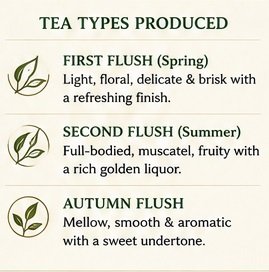
The first flush harvest — typically from mid-March to late April — produces Alubari’s most celebrated and eagerly anticipated teas. After the long winter dormancy at high altitude, the first new shoots that emerge from Alubari’s ancient tea bushes carry an intensity and concentration of flavor that is unmistakably high-mountain in character.
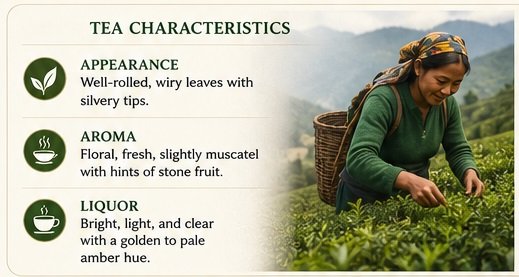
Appearance of the dry leaf: Fine, twisted whole leaves with silver-green tips — characteristic of a well-made, lightly oxidized first flush. The leaves carry the distinctive greenish hue of minimal oxidation.
Liquor color: Remarkably pale — a soft, luminous gold with greenish tints, almost like a light-colored white wine. At high altitude, first flush liquors tend to be even paler than lower-elevation teas from the same flush.
Aroma: Intensely floral — orchid, jasmine, lily, with a clean, fresh mountain-air quality underneath. Some lots carry a light citrus brightness (lemon zest, bergamot) and a subtle, almost mineral note that speaks directly to the high-altitude terroir.
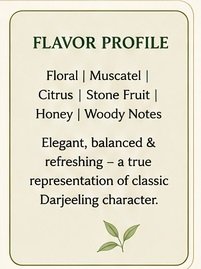
Flavor: Delicate and layered — spring florals on the first sip, followed by a gentle vegetal freshness, a clean briskness that refreshes rather than astringes, and a long, lingering floral finish. Some first flush lots from Alubari carry what connoisseurs describe as “a refined muscatel whisper” — a very subtle hint of the grape-like sweetness that becomes fully pronounced in the second flush, present here like a distant fragrance rather than a dominant note.
Mouthfeel: Light, airy, refreshing — the “first sip of spring” in a cup.
Best enjoyed: Plain, without milk, in a glass or porcelain cup. Brew at 85°C for 2–3 minutes. The pale color is not a sign of weakness — it is the hallmark of the finest high-altitude first flush.
☀️ Second Flush — The Summer Depth
The second flush of Alubari — harvested from May to mid-June — presents an entirely different and richer face of the estate. As the weather warms and the tea plants enter their most vigorous growing phase, the leaves develop more body, more depth, and the hallmark quality of great Darjeeling summer tea: muscatel.
Appearance of the dry leaf: Darker, more twisted leaves with amber and copper tones — reflecting higher oxidation. More golden tips visible than in the first flush.
Liquor color: Deep amber to copper-gold — rich and luminous, with a characteristic brightness at the rim of the cup.
Aroma: The muscatel note arrives — that warm, sun-dried-grape, wine-like character that defines second flush Darjeeling at its best. Alongside it: hints of apricot, stone fruit, honey, and a spiced warmth that speaks of summer afternoons in the Himalayas.
Flavor: Fuller-bodied than first flush, with a round, mouth-filling quality. The muscatel is the defining note — complex, layered, and long on the finish. Less astringent than first flush, with a warmth and depth that rewards slow, attentive sipping.
Mouthfeel: Medium to full body, smooth and enveloping — the “summer afternoon” to first flush’s “spring morning.”
Best enjoyed: Plain or with a very small amount of milk. Brew at 90–95°C for 3–4 minutes.
🍃 Green Tea from Alubari
At such high altitude, with tea plants evolved for cool conditions and slow growth, green tea — produced with minimal oxidation after harvesting — is a natural expression of Alubari’s terroir. The same characteristics that give the first flush its distinctive freshness and high antioxidant content produce a green tea of remarkable purity and delicacy.
Alubari’s green tea is characterized by a clean, high-mountain freshness — less grassy than Japanese green teas, more floral and mineral, with a clarity that reflects the altitude from which it comes. It is typically brewed at 75–80°C for 1–2 minutes.
🤍 White Tea from Alubari
The estate also produces white tea — the most minimally processed of all tea categories, made from only the youngest buds and leaves, simply withered and dried. At an altitude of 2,300 metres, the buds that emerge in early spring carry extraordinary concentration of antioxidants, amino acids, and aromatic compounds accumulated through winter dormancy.
Alubari white teas are prized for their delicate honeyed sweetness, subtle floral notes, and exceptional gentleness — ideal for those who want the health benefits of Darjeeling’s high-altitude terroir in the lightest, most refined form possible.
Part 5: The Tea Bush Heritage — China Plants and Clonal Cultivars
The China Bush Legacy
The original tea bushes planted at Alubari in the 1850s were China-origin plants (Camellia sinensis var. sinensis) — seeds sourced from government nurseries that had been established from Chinese tea varieties brought to India by Dr. Campbell and Scottish botanist Robert Fortune, who famously infiltrated Chinese tea-growing regions to bring back seeds and processing knowledge for the British colonial enterprise.
These original China-variety plants are small-leafed, slow-growing, and exquisitely sensitive to environmental conditions. They have been growing on the hillsides of Alubari for over 170 years — making them among the oldest cultivated tea plants in India. Old China-variety bushes develop extraordinarily deep root systems over decades, accessing nutrients and moisture from deep within the Himalayan soil that younger plants cannot reach. This is one reason why century-old tea gardens often produce teas of greater complexity and depth than newer plantings.
What Old Bushes Mean for Flavor
Tea professionals distinguish between teas from “old bushes” and those from newer clonal plantings. Old China-variety bushes at high altitude, like those at Alubari, produce:
- Lower yield per bush — fewer leaves, each one more concentrated
- Greater complexity — the deep root system accesses a broader mineral profile
- More consistent seasonal character — established bushes respond more predictably to seasonal changes than younger plants
- Higher natural polyphenol content — the slow growth rate concentrates flavor and health compounds
The combination of Alubari’s original China-variety bushes, its 170-year root establishment, and its exceptional altitude makes its teas genuinely irreplaceable — impossible to replicate anywhere else on earth.
Part 6: Alubari’s Place in the Founding Three
It is worth pausing to fully appreciate the company Alubari keeps in Darjeeling’s founding history.
The Founding Three of 1852
The three estates established in 1852 from government nursery seeds were:
| Estate | Then | Now | Status |
|---|---|---|---|
| Tukvar | First experimental garden, planted by Dr. Campbell | Puttabong Tea Estate (Jay Shree Tea) | Active, largest estate in Darjeeling |
| Steinthal | Founded by German missionary Joachim Stoelke | Steinthal Tea Estate | Active |
| Alubari (Aloobari) | Founded under Kurseong & Darjeeling Tea Company | Alubari Tea Estate | Active |
All three founding estates of 1852 remain operational today — a remarkable testament to the quality of the land chosen in those early years and the enduring value of high-altitude Himalayan tea cultivation.
What Followed Alubari
The establishment of Alubari in 1852–1856 was quickly followed by rapid expansion of the Darjeeling tea industry:
- 1854: Happy Valley Tea Estate established
- 1859: Glenburn Tea Estate established; Makaibari factory commissioned
- 1864: Margaret’s Hope Tea Estate established
- 1866: 39 tea gardens operating in Darjeeling, producing 21,000 kg of tea
- 1870: 56 tea gardens, producing 71,000 kg of tea
- 1892: Darjeeling Planters’ Association formed
- 2004: Darjeeling tea receives India’s first GI (Geographical Indication) tag
The exponential growth of Darjeeling’s tea industry in the second half of the 19th century was made possible by the proof-of-concept that Alubari and its founding siblings provided: that this Himalayan hillside could produce extraordinary tea commercially.
Part 7: The Ownership Journey
Colonial Origins
Alubari was established under the stewardship of the Kurseong and Darjeeling Tea Company — the colonial-era commercial entity that oversaw the earliest tea development in the Darjeeling hills. This company operated during the height of British colonial rule in India, managing multiple estates as part of a broader commercial strategy to develop India as a global tea-producing nation.
Post-Independence Evolution
Like most Darjeeling tea estates, Alubari’s ownership has evolved significantly since Indian independence in 1947. The colonial-era company structures were gradually replaced by Indian business entities, family-owned operations, or corporate tea groups that have taken stewardship of Darjeeling’s gardens over the decades.
Today, Alubari’s ownership reflects the broader pattern seen across Darjeeling: dedicated stewardship committed to preserving the estate’s historical legacy while adapting to modern quality standards, sustainability expectations, and international market demands.
The estate’s contemporary proprietors have maintained the integrity of the garden while adhering to eco-friendly practices and the international quality standards that allow Darjeeling teas to access premium global markets.
Part 8: Quality, Certification, and Standards
The GI Mark
Like all 87 operational Darjeeling tea estates, Alubari’s teas carry the Darjeeling GI certification mark — the distinctive logo issued by the Tea Board of India that guarantees the tea was grown and produced within the Darjeeling district. This GI protection, India’s first, ensures that no tea from outside the district can legally be sold as “Darjeeling Tea.”
When purchasing Alubari teas, look for this mark on the packaging — along with the DJ lot number, a traceability identifier that links the specific tea back to its exact batch, estate, flush, and season.
Eco-Friendly and Quality Practices
Alubari’s teas are recognized for their adherence to eco-friendly practices and minimal processing — an approach that preserves the natural integrity of the leaf and meets the refined standards expected by global specialty tea consumers. The estate’s commitment to quality over quantity reflects the philosophy shared by the finest Darjeeling gardens: that this extraordinary terroir deserves to be expressed as purely and authentically as possible.
Tea Grades from Alubari
Like all orthodox Darjeeling estates, Alubari’s teas are sorted and classified according to the standard Darjeeling leaf grading system. The highest-quality whole-leaf teas from the estate carry grades such as:
- FTGFOP1 — Finest Tippy Golden Flowery Orange Pekoe, Grade 1: the premium whole-leaf grade with abundant golden tips, associated with the estate’s finest first and second flush lots
- TGFOP / TGFOP1 — Tippy Golden Flowery Orange Pekoe: excellent whole-leaf with good tip content
- GFOP / FOP — Good quality whole-leaf, slightly less tip-abundant than TGFOP grades
- BOP — Broken Orange Pekoe: broken-leaf grade for a stronger, faster-brewing cup; used in blends

Part 9: Brewing Alubari Tea — Getting the Most from Every Cup
The exceptional quality of Alubari tea deserves an equally careful approach to brewing. Here is a complete guide to getting the best from each type:
Brewing Alubari First Flush
Water: Fresh, filtered water — soft to neutral mineral content. Avoid hard tap water; chlorine and excessive minerals will flatten the delicate florals.
Temperature: 85–88°C — never boiling. Boiling water will scorch the delicate first flush leaves, releasing harsh tannins and destroying the high-altitude aromatics you are paying for.
Quantity: 2–3 grams per 200 ml (approximately 1 heaped teaspoon of loose leaf)
Steeping time: 2 to 2.5 minutes — time carefully. Over-steeping first flush at high temperature is the most common mistake and produces a bitter, astringent cup.
Vessel: Glass or porcelain — clear glass is particularly beautiful for watching the pale golden liquor develop.
Milk: Absolutely not. Milk proteins bind to catechins and flatten the aromatic profile completely.
Multiple infusions: Quality FTGFOP1 first flush can yield 2–3 infusions. The second infusion (1.5 minutes, same temperature) often reveals different, sometimes more floral notes.
Brewing Alubari Second Flush
Water: Fresh, filtered water
Temperature: 90–95°C
Quantity: 2–3 grams per 200 ml
Steeping time: 3–4 minutes
Milk: Optional — a very small amount will not overwhelm the second flush’s fuller body, but it remains best experienced plain to fully appreciate the muscatel character.
Brewing Alubari Green Tea
Water: Fresh, filtered water
Temperature: 75–80°C
Quantity: 2 grams per 200 ml
Steeping time: 1.5–2 minutes
Milk: Never
Brewing Alubari White Tea
Water: Fresh, filtered water
Temperature: 75–80°C
Quantity: 3–4 grams per 200 ml (white tea is less dense than black)
Steeping time: 3–4 minutes
Milk: Never
Multiple infusions: White tea yields excellent 3–4 infusions, each revealing subtly different character.
Part 10: How to Identify and Buy Authentic Alubari Tea
What to Look For on the Label
Genuine Alubari Tea Estate tea should clearly state:
- Estate name: “Alubari” or “Aloobari” Tea Estate, Darjeeling
- Flush: First Flush, Second Flush, Monsoon, or Autumnal (with year)
- Leaf grade: FTGFOP1, TGFOP1, BOP etc.
- The Darjeeling GI logo — the distinctive certification mark from the Tea Board of India
- DJ lot number (on specialty or estate-direct purchases)
Where to Buy
Authentic Alubari teas are available through:
- Specialty Darjeeling tea importers and retailers in India, Germany, Japan, the UK, and the US
- Darjeeling-specific online stores that source directly from estates
- Premium tea boutiques in major Indian cities
- Potentially directly through estate-affiliated distributors
Because Alubari is a limited-production estate, its teas sell out relatively quickly each season — particularly the first flush. If you are interested in a specific lot, purchasing early in the season (March–May for first flush) is advisable.
Pricing: What to Expect
Authentic first flush Alubari teas — particularly FTGFOP1 whole-leaf lots — are premium products. Expect to pay:
- ₹800–2,500+ per 100 grams for quality first flush whole-leaf grades in the Indian market
- Higher prices for certified organic or particularly rare lots
- Second flush at comparable or slightly lower price points depending on the muscatel character of the specific lot
Be cautious of products labeled “Darjeeling” or even “Alubari” that are priced significantly below these ranges — authentic, high-altitude, limited-production first flush tea cannot be produced cheaply.
Part 11: Alubari and Darjeeling’s Tea Community
The Workers of Alubari
Every cup of Alubari tea represents the labor and skill of the estate’s permanent and seasonal workforce — the workers who pluck, wither, roll, oxidize, fire, and sort the leaves through each flush season. Like most Darjeeling estates, Alubari’s workforce is predominantly drawn from the local Gorkha / Nepali community of the Darjeeling hills, with women constituting the majority of field pluckers.
These workers — who begin their day before dawn and walk steep Himalayan slopes in all weather conditions — are the human foundation on which Darjeeling’s tea heritage rests. The growing movement toward fair trade certification and ethical sourcing across Darjeeling is a direct reflection of increasing awareness that the value of Darjeeling tea must be shared with those who create it.
The Village Community
The Alubari Tea Garden is not just an estate — it is also a living community. As per the 2011 Census, the village associated with Alubari Tea Garden has a population of 116 people with 27 households — a small, tightly-knit community whose lives are inseparably connected to the rhythms of the tea garden: the waiting through winter dormancy, the anticipation of first flush, the intensity of the plucking seasons, and the quiet of the post-autumnal rest.
Part 12: Visiting Alubari Tea Estate
Getting There
Alubari Tea Estate is located approximately 5 to 11 kilometres from the centre of Darjeeling town, in the north-eastern direction. The estate is accessible by road — though like most Darjeeling gardens, the route involves steep, narrow mountain roads that are best navigated with a local driver familiar with the terrain.
From Darjeeling town: Shared jeeps, private taxis, or arranged estate transport
Nearest major transport hub: New Jalpaiguri (NJP) railway station (~3 hours by road) or Bagdogra Airport (~3.5 hours by road)
Best seasons to visit: March–April (first flush, best weather), May–June (second flush, lush green gardens), October–November (autumnal flush, clear skies, Kanchenjunga views)
What to See and Experience
A visit to Alubari during flush season offers the opportunity to:
- Walk through the tea garden and see the plucking of “two leaves and a bud” up close
- Understand the altitude and the remarkable growing conditions that define this estate’s character
- Visit the processing factory and witness withering, rolling, oxidation, and firing
- Participate in a tasting session — experiencing the same tea before and after processing, or comparing different flushes side by side
- Absorb the history — knowing that you are walking on land that was first planted with tea nearly 175 years ago, when the entire Darjeeling tea industry was just beginning
Note: For the most current visiting arrangements and hours, contact the estate directly or through a Darjeeling tea tourism specialist, as these can change seasonally.
The Story Behind the Flavor: Why Alubari Tea Tastes Like It Does
Every sip of Alubari tea is the product of a specific and irreproducible combination of factors:
| Factor | Alubari’s Specific Contribution |
|---|---|
| Altitude (2,300 m) | Slow growth, concentrated flavors, high L-theanine and EGCG content |
| China-variety bushes (170+ years old) | Deep roots, complex mineral access, depth and complexity |
| Himalayan soil (loamy, acidic, well-drained) | Mineral clarity, clean profiles |
| Mist and cool temperatures | Preserved aromatics, high catechin retention |
| Limited production | Careful attention per plant; quality over volume |
| Founding-era terroir | Undisturbed, established ecosystem developed over 170+ years |
| Traditional orthodox processing | Preserves whole-leaf integrity, complexity, and nuance |
| GI-protected geography | Authentic Darjeeling provenance; no imitation possible |
This is why Alubari teas taste the way they do — and why that taste cannot be replicated anywhere else on earth.
Frequently Asked Questions About Alubari Tea Estate
Q: What does Alubari mean?
“Alubari” is a Bengali/Nepali compound word meaning “potato field” — a reference to the agricultural land that was transformed into a tea garden in the mid-19th century.
Q: When was Alubari Tea Estate established?
Alubari is among Darjeeling’s founding three commercial tea gardens, with historical records placing its establishment between 1852 and 1856. The Darjeeling Gazetteer specifically cites 1856 as the year it was formally opened as a commercial garden under the Kurseong and Darjeeling Tea Company.
Q: Who founded Alubari Tea Estate?
Captain Samler — a British military officer and agent of the Kurseong and Darjeeling Tea Company — is credited with establishing the Alubari tea garden, as recorded in the Darjeeling Gazetteer.
Q: What is the altitude of Alubari Tea Estate?
Alubari Tea Estate is situated at approximately 2,300 metres (around 7,545 feet) above sea level — one of the higher-altitude gardens in Darjeeling.
Q: What types of tea does Alubari produce?
Alubari produces black tea (first flush and second flush), green tea, and white tea, all processed using traditional orthodox methods.
Q: Is Alubari one of the oldest tea estates in Darjeeling?
Yes. Alubari is one of Darjeeling’s three founding commercial tea gardens, established alongside Tukvar (now Puttabong) and Steinthal in 1852. It is among the oldest tea estates in all of India.
Q: What makes Alubari tea special?

The combination of extreme age (170+ years of established China-variety bushes), exceptional altitude (2,300 m), Himalayan terroir, limited production, and founding historical significance makes Alubari tea genuinely unique — impossible to replicate anywhere else in the world.
Q: How should I brew Alubari first flush tea?
Use fresh filtered water at 85–88°C, steep 2–3 grams per 200 ml for 2 to 2.5 minutes, and enjoy without milk. Never use boiling water — it will destroy the delicate floral aromatics.
Q: Where can I buy authentic Alubari tea?
Through specialty Darjeeling tea retailers and importers online, premium tea boutiques in India, or directly through estate-affiliated distributors. Always look for the Darjeeling GI certification mark and the DJ lot number for authenticity.
The Gelassen Perspective: The Weight of History in a Single Cup
There is something deeply moving about Alubari Tea Estate that goes beyond flavor and altitude and chemistry.
When you brew a cup of Alubari first flush — watching that pale, luminous gold liquor develop in your cup — you are in relationship with a place that has been growing tea continuously for nearly 175 years. You are drinking from land that was first transformed for this purpose when India itself was still under colonial rule, when Darjeeling had barely 20 families, when the very idea that these Himalayan slopes could produce the finest tea in the world was still an unproven experiment.
Captain Samler planted the first seeds here. Dr. Campbell had proven the concept in his garden a decade before. The Kurseong and Darjeeling Tea Company built the infrastructure. And then, season after season, generation after generation — winter dormancy, spring awakening, summer richness, autumn quiet, winter again — the plants kept growing. The hands that plucked them changed, the owners changed, the world changed entirely around them. But the bushes remained, and the mist kept coming in from the valley each morning, and the soil kept feeding the roots, and the roots kept feeding the leaves.
That is what you taste in a cup of Alubari tea: continuity. History as flavor. The patience of a place that has been doing one thing beautifully for 175 years.
This is the gelassen cup — unhurried, grounded, fully present, and quietly extraordinary.
Explore more about tea culture, wellness, and mindful living at gelassen.in